

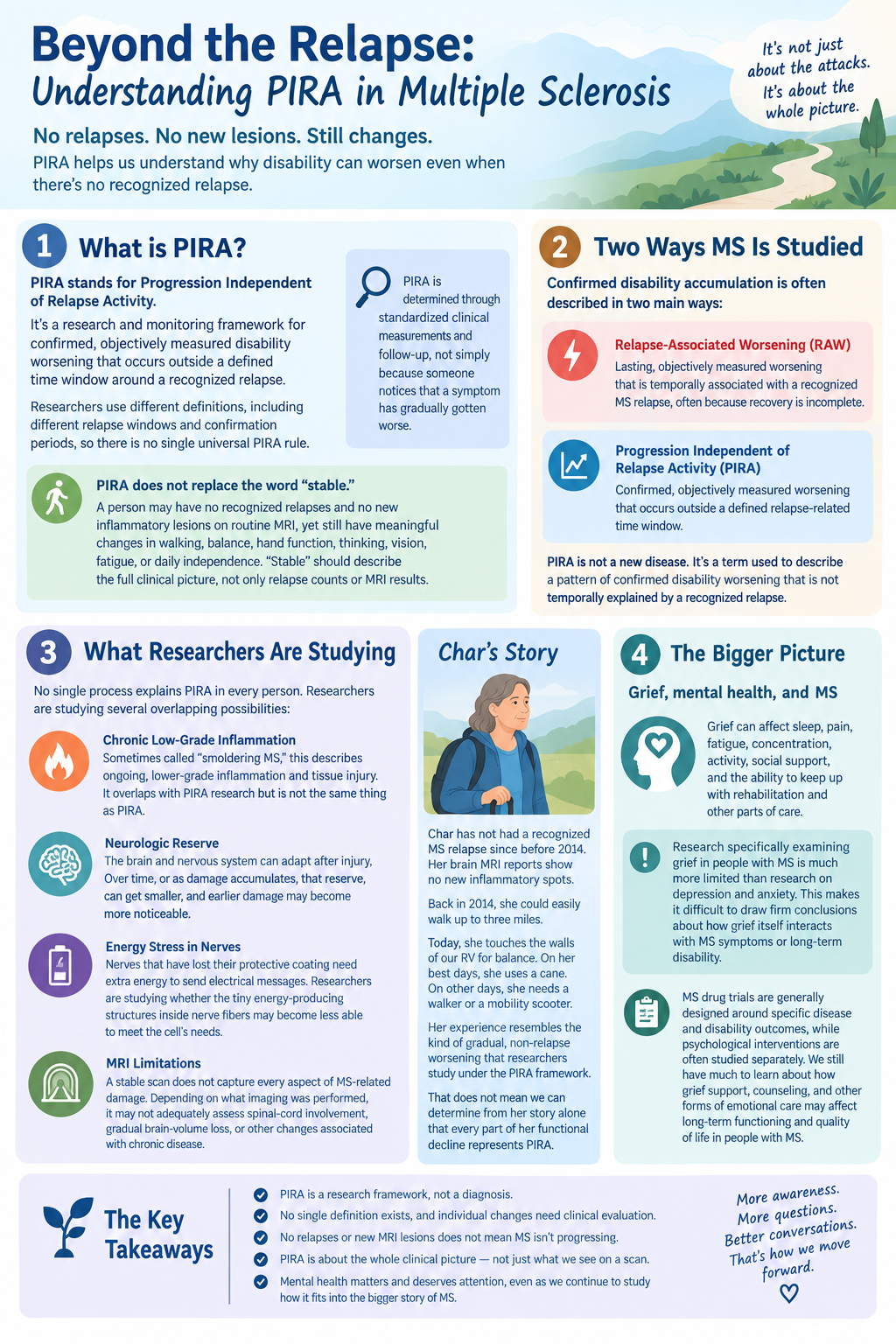
We need to talk about PIRA, which stands for Progression Independent of Relapse Activity.
Recently, I have seen online discussions about PIRA that oversimplify research findings or take scientific studies out of context. PIRA is important, but it needs to be explained carefully.
In simple terms, PIRA is a framework researchers use to study one important question: Why can disability worsen even when a person has not had a recognized relapse in years?
A Real-World Example: Char’s Story
To see what this looks like in real life, let us look at Char’s story.
Char has not had a recognized MS relapse since before 2014. That was the year she began treatment with Gilenya, a disease-modifying therapy, or DMT. Her routine brain MRI reports did not show new inflammatory spots. Back in 2014, she could easily walk up to three miles.
Her MS is considered “Stable”.
Over the years, however, that walking distance got shorter and shorter. Today, she touches the walls of our RV for balance. On her best days, she uses a cane. On other days, she needs a walker or a mobility scooter to move around safely.
That is not stable function. Even if relapse activity and routine brain MRI appear stable, a meaningful loss of walking ability and independence deserves to be recognized and evaluated.
When she met with her new MS neurologist at USF in Tampa for the first time in early 2025, progression was part of the conversation right from day one. Even though she had no sudden attacks for over ten years, her body was still changing.
Char’s experience resembles the kind of gradual, non-relapse worsening that researchers study under the PIRA framework. That does not mean we can determine from her story alone that every part of her functional decline represents PIRA.
PIRA is a research and monitoring framework for confirmed, objectively measured disability worsening that occurs outside a defined time window around a recognized relapse. Researchers use different definitions, including different relapse windows and confirmation periods, so there is no single universal PIRA rule.
1. Two Ways MS Is Studied
In MS research, confirmed disability accumulation is often described in two main ways. Individual changes still need clinical evaluation because more than one cause can be present:
- Relapse-Associated Worsening (RAW): Lasting, objectively measured worsening that is temporally associated with a recognized MS relapse, often because recovery is incomplete.
- Progression Independent of Relapse Activity (PIRA): Confirmed, objectively measured worsening that occurs outside a defined relapse-related time window.
PIRA is not a new disease. It is a term used to describe a pattern of confirmed disability worsening that is not temporally explained by a recognized relapse. It can happen even in people who were diagnosed very early.
PIRA does not replace the word “stable.” It challenges us to be specific about what is stable.
PIRA is determined through standardized clinical measurements and follow-up, not simply because someone notices that a symptom has gradually gotten worse.
A person may have no recognized relapses and no new inflammatory lesions on routine MRI, yet still have meaningful changes in walking, balance, hand function, thinking, vision, fatigue, or daily independence. “Stable” should describe the full clinical picture, not only relapse counts or MRI results.
2. What Researchers Are Studying
No single process explains PIRA in every person. Researchers are studying several overlapping possibilities to understand why MS can get worse without a relapse:
Chronic Low-Grade Inflammation
Researchers sometimes use the informal term smoldering MS to describe chronic, lower-grade inflammation and tissue injury that may persist within the central nervous system. It overlaps with PIRA research but is not the same thing as PIRA.
Think of a campfire where the big flames are gone, but tiny hot coals are still glowing underneath. This metaphor is one way to think about disease processes that may not appear as a new, obvious inflammatory lesion on routine MRI. It does not prove that every stable scan or gradual symptom change is caused by this process.
The campfire metaphor has another lesson: when the flames are gone, the coals still deserve attention. In MS, this means looking beyond relapses and new MRI lesions to track changes in walking, balance, hand function, thinking, vision, fatigue, and daily life.
The metaphor is not meant to say that anyone failed to “put out” their disease. It is a reminder that MS monitoring needs to include more than visible attacks.
Neurologic Reserve
The brain and nervous system can sometimes adapt after injury by using alternative networks or strategies. This ability to compensate is often described as neurologic reserve.
Over time, or as damage accumulates, that reserve can get smaller. When there are fewer backup paths available, older damage can start showing up as new trouble with walking or balance.
Energy Stress in Nerves
Nerves that have lost their protective coating need extra energy to send electrical messages. Researchers are studying whether the tiny energy-producing structures inside stressed nerve fibers may become less able to meet the cell’s energy needs over time, making it harder for nerves to do their work.
3. What Routine MRI Scans Show
People often ask: If walking is getting harder, why does my MRI scan look fine?
A scan with no new inflammatory lesions is good news. It suggests that treatment may be controlling much of the acute inflammatory activity visible on routine MRI.
However, routine MRI pictures do not measure every single detail. A stable scan does not always capture changes in the spinal cord, slow loss of brain volume over time, or subtle wear-and-tear that happens gradually over many years. A neurologist may also consider symptoms, examination findings, spinal-cord imaging when appropriate, medication effects, rehabilitation needs, and other health conditions.
4. Mental Health, Grief, and What Science Is Learning
When physical function slips away without any sudden attack, the emotional impact is real and deep. It is important to look at how feelings and physical health connect.
Charlene’s Experience With Grief
In December 2024, Charlene lost her son. In the period after his death, we saw a marked change in her day-to-day function. Since then, walking, balance, energy, and independence became more difficult.
It would be wrong to say that grief caused Charlene’s MS progression. MS progression has many possible contributors, and no one can determine the cause of an individual change from timing alone. But major grief can affect sleep, pain, fatigue, concentration, activity, social support, and the ability to keep up with rehabilitation and other parts of care.
Her experience is a reminder that grief deserves to be treated as part of whole-person MS care. Mental-health and grief support do not replace MS treatment, but they can be an important part of helping someone cope, stay connected, and maintain as much day-to-day function and quality of life as possible.
Grief vs. Depression
People living with MS may experience recurring grief. Grieving is a natural response to losing something or someone important, such as the loss of a loved one or losing the ability to walk three miles without support.
At the same time, clinical depression is common in MS. Depression can reflect many connected factors, including the stress of a long-term illness, changes in daily independence, sleep trouble, pain, and MS-related changes in mood networks in the brain.
Important Research Gaps
- Separating Grief from Depression: Research specifically examining grief in people with MS is much more limited than research on depression and anxiety. This makes it difficult to draw firm conclusions about how grief itself interacts with MS symptoms or long-term disability.
- No One Is to Blame: A person is not responsible for their MS progression because they experienced grief, depression, or stress. High stress, grief, depression, and poor sleep can affect fatigue, pain, concentration, motivation, activity levels, and day-to-day functioning. However, research does not show that a person’s grief, stress, or sadness caused their MS to progress. No one should ever feel blamed for their physical symptoms.
- Mental Health in Drug Studies: MS drug trials are generally designed around specific disease and disability outcomes, while psychological interventions are often studied separately. That means we still have much to learn about how grief support, counseling, and other forms of emotional care may affect long-term functioning and quality of life in people with MS.
5. Practical Steps You Can Take
If you notice slow shifts in your daily strength or balance, here are helpful steps to take with your healthcare team:
- Keep a Structured Note Log: Track changes over weeks or months. Focus on changes from your usual baseline, not only how you feel on your hardest days. Record walking distance or time, falls or near-falls, use of mobility aids, fatigue, sleep quality, heat exposure, infections, pain, and treatment changes.
- Ask for Repeatable Functional Tests: Ask your clinic if they can track the same measures over time, such as a Timed 25-Foot Walk, 9-Hole Peg Test, balance checks, vision testing, or cognitive screening when relevant.
- Take Care of Your Feelings: Remember that feeling sad or stressed is real and understandable. Talk with your doctor about counseling or mental health support as part of your overall care.
- Work with a Physical Therapist: A physical therapist familiar with MS can help tailor strategies for strength, balance, gait, fatigue management, fall prevention, safe mobility-aid use, and daily activities.
- Talk Openly with Your MS Neurologist: Share your structured notes with your MS specialist so you can look at the full picture of your health together.
Learning about PIRA is not about assuming that every new problem is irreversible MS progression. It is about noticing sustained changes, measuring them over time, and bringing the full picture to the MS care team. Relapse prevention, symptom care, rehabilitation, mental-health support, and attention to other health conditions can all matter.
6. Key Scientific Resources & Studies
To learn more about the research behind PIRA, smoldering MS, and disability tracking, you can explore these key peer-reviewed studies:
- Disability Accumulation and PIRA in Relapsing MS: Kappos et al., JAMA Neurology (2020) https://pubmed.ncbi.nlm.nih.gov/32511687/ This landmark study analyzed pooled data from major clinical trials, showing that most disability accumulation in relapsing MS occurs independently of overt relapses.
- The “Smoldering MS” Concept: Giovannoni et al., Therapeutic Advances in Neurological Disorders (2022) https://pmc.ncbi.nlm.nih.gov/articles/PMC8793117/ A foundational paper exploring chronic, low-grade central nervous system inflammation and why disease progression can happen underneath quiet routine scans.
- Early PIRA and Long-Term Outcomes: Tur et al., JAMA Neurology (2023) https://pmc.ncbi.nlm.nih.gov/articles/PMC9856884/ Research investigating how non-relapse worsening can occur early after a first demyelinating event and its association with long-term disability tracking.
- Blood Biomarkers for Progression (sGFAP vs. sNfL): Benkert et al., Annals of Neurology (2024) https://pubmed.ncbi.nlm.nih.gov/39411917/ A longitudinal study examining serum GFAP and neurofilament light chain (NfL) in people with MS receiving B-cell-depleting therapy. Elevated GFAP and persistently elevated NfL were associated with an increased risk of future PIRA.
Educational Note
This article is for educational purposes only and is not personal medical advice. Always talk to an MS clinician about any new or changing symptoms.