

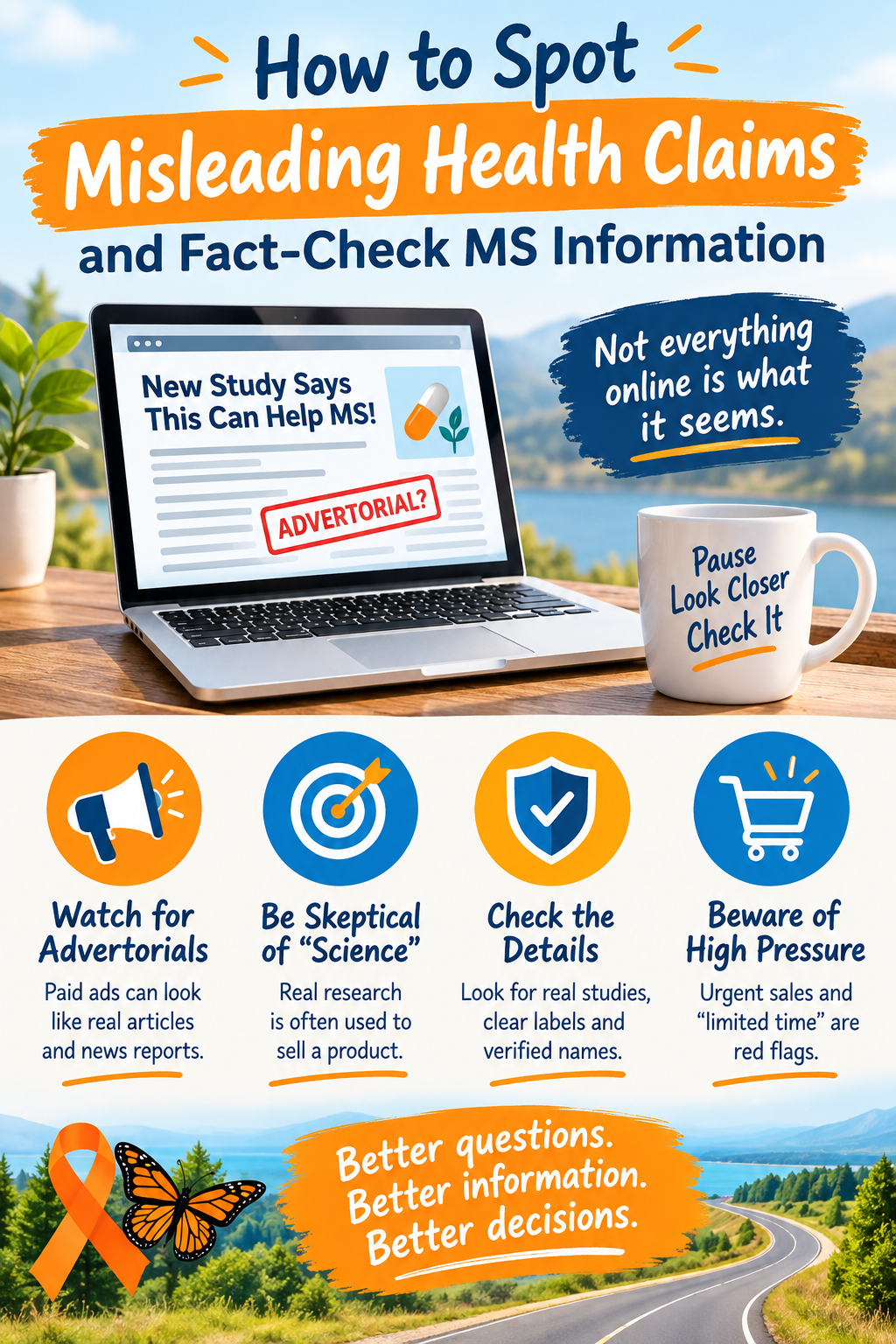
How to Tell If Online Health Advice Deserves Your Trust
When you live with MS, or any long-term illness, you learn to pay close attention to your body. You notice what helps, what makes things worse, and what does not match your medical test results.
When you see a post online that seems to explain all your symptoms, like feeling tired, sore, or stiff, it makes sense to stop and read it. The internet can be a great place to learn, connect with other people, and find good questions for your doctor. However, it can also make a tiny study, a personal story, or an ad look like proven medical advice.
Doing your own research does not mean believing everything you read. It means slowing down to ask a few smart questions before you trust, share, buy, or change your medical routine.
What Is an Advertorial?
An advertorial (a word made by combining advertisement and editorial) is paid advertising presented in the style of an article or news report.
Some advertorials are clearly labeled and follow advertising rules. Others misleadingly resemble independent reporting, making it harder to recognize that someone is trying to sell you something.
How Advertising Blends Into Health Information
Advertising can look like an article, news report, or educational guide. The important question is whether readers can recognize that it is advertising rather than independent reporting.
Online health marketing can use several approaches:
- Targeted Advertising: Health-related online activity or information can be used to target ads. Seeing an ad that closely matches your concerns does not mean the product has been medically recommended for you.
- News-Style Designs: Some sales pages resemble news websites or independent health reports. A professional design, personal story, or link to research does not establish that the advertised product works.
- Hard-to-See Labels: Under U.S. truth-in-advertising rules, ads must not mislead readers into thinking they are independent reporting. When a disclosure is needed, it must be easy to notice and understand. Labels such as “Advertisement” or “Paid Advertisement” are clearer than vague sponsorship language. A label buried at the bottom, printed in faint text, or hidden behind a menu may not be adequate.
Why Misleading Health Posts Work
Many misleading health posts can start with real facts:
- They Understand Your Pain: They describe symptoms you know very well, like waking up stiff or feeling exhausted by two in the afternoon. They match your feelings when a doctor says your scans look stable, but your body still feels terrible.
- They Use Real Science Words: They use real medical terms like “smoldering MS” or link to actual scientific studies about human body tissue.
- They Make an Unfair Jump: Once you agree with the real science, they make a claim without proof. They say one hidden problem causes all your symptoms, and they claim their special pill, device, or program is the secret fix your doctor missed.
Four Warning Signs of Misleading Health Marketing
- Unverified Logos and Names: A familiar logo is not proof of endorsement. A seller may use a hospital’s or government agency’s name without permission, or suggest a connection that does not exist. Check the institution’s own website to confirm the specific relationship. Some hospitals sell supplements or recommend them in certain situations, but that does not validate an unrelated seller’s claims.
- Science Words Used as a Sales Trap: Some pages take real research about human tissue or nerves and use it to set up a problem, then claim their specific supplement or program is the only answer.
- Misleading Claims About Clinical Testing: Saying a product is “clinically tested” does not necessarily mean it is “proven to work.” Look for well-designed human studies that actually support the advertised claim. Check whether the research tested the same product, dose, and intended use, whether it included a suitable comparison group, and whether the study was large enough to support its conclusions. Check whether the seller is describing a controlled clinical trial, a customer survey, or something else entirely.
- High-Pressure Sales: Pay attention to how the article ends. Countdown timers, urgent “check stock” messages, and pressure to buy before an offer disappears indicate a sales pitch, not scientific evidence. A money-back guarantee is also not proof that a product works. Check its terms rather than treating it as evidence of a health benefit.
Understanding Health Product Rules
Two key federal agencies oversee health-product claims in the United States:
- The Federal Trade Commission (FTC): Addresses deceptive advertising, including misleading health-benefit claims and ads disguised as independent content.
- The Food and Drug Administration (FDA): Regulates dietary supplements and other health products, including applicable safety, manufacturing, and labeling requirements.
Rules on Supplements and Disease Claims
Products marketed as dietary supplements cannot lawfully make claims to diagnose, treat, cure, mitigate, or prevent diseases such as MS without meeting the requirements that apply to drugs. A seller cannot avoid those requirements simply by calling the product a supplement.
How Enforcement Works
Enforcement can take time, and agencies use different tools, including warning letters, administrative proceedings, settlements, and court actions. A misleading product or advertisement may remain available while a matter is being investigated or addressed.
Some deceptive marketing operations use multiple companies, brands, or websites, which can make them harder for consumers to identify. The FTC has brought cases involving networks of sellers using fake news sites and unsupported health claims. Enforcement can lead to monetary judgments, restrictions on marketing practices, and bans on selling certain products.
A 5-Question Fact-Checking Checklist
You do not need to be a doctor to check health news. You just need to ask five simple questions:
- Who is behind this information? Look for the author, publisher, relevant qualifications, funding, and financial interests. Identify who benefits if you buy.
- What exactly is being claimed? Separate symptom relief from claims about treating MS itself. Be cautious about guarantees, secret cures, and claims that one simple explanation accounts for everything.
- Does the evidence support this exact claim? Does the post identify the original study so you can check it yourself? PubMed can help you find medical research, but appearing in PubMed does not mean a study is correct or endorsed by the government. Check whether the research involved the people the claim is about. For an MS-specific treatment claim, look for studies in people with MS. Check whether the researchers tested the same product, dose, and outcome being advertised. One study is not the whole picture. Look for whether its findings agree with other good-quality research.
- Is this information, advertising, or both? Look for advertising labels, sales links, affiliate relationships, and pressure to purchase. Advertising is not automatically false, but it should be easy to identify and its claims must be supported.
- What should I verify before acting? Bring the specific claim or product to your doctor or pharmacist, especially before changing your treatment or adding a new supplement.
Checking Government Records Yourself
If you want to see if a health company has faced government action, you can search public records online:
- FDA Warning Letters: Search the FDA Warning Letters website using the company or brand name. Check the letter’s date and any later updates, as companies may correct issues after a letter is sent.
- FTC Legal Cases: Search the FTC Legal Library. Be sure to distinguish between allegations in an initial complaint, a settlement, and a court’s final findings.
- Look at the Fine Print: Look for the legal business name in the Privacy Policy, Terms of Use, contact information, and checkout details. Search any identified company names as well as the brand name.
Please note that finding no warning letter or legal case does not prove that a company or product is safe, effective, or lawful. A database search is only one helpful step.
Using AI to Fact-Check (Safely)
AI tools can save time and help explain hard science words, but you must use them carefully.
Safety and Usage Tips
- Check Web Access: Not every AI tool can search the live web. If an AI tool cannot open live links, use it to organize questions or explain text rather than verify if a claim is true right now.
- Protect Your Privacy: Do not paste identifiable medical records or sensitive personal information into an AI tool without understanding its privacy settings.
- Verify Sources Yourself: Always open and read the original study links yourself.
A Fact-Checking Prompt You Can Use
When you find a post that seems suspicious, copy and paste the text into an AI tool along with this prompt:
Copy from here>
I am going to paste an article. Fact-check it using these steps:1. First, state whether you can search the live web and open external sources directly.2. List the checkable factual claims (such as names, dates, numbers, quotes, or cause-and-effect claims), splitting compound claims into separate statements. Number each one.3. For each claim, look for credible supporting and contradicting evidence and give me: a verdict (Supported, Contradicted, Partly supported, Mixed or insufficient evidence, or Unverifiable), the source URL, the specific study result or passage found, and a short note in your own words.4. Only use sources you actually retrieve in this session. Never guess or make up a link. If you cannot retrieve a relevant source or the claim cannot be checked from the available information, mark it “Unverifiable.” If relevant research exists but is too limited or conflicting to support a conclusion, use “Mixed or insufficient evidence.” Neither verdict automatically means the claim is false..5. Prefer primary sources like official records or original research over general news stories.6. At the end, list the claims you are least sure about and explain why.7. If you are not sure, say so clearly. Do not make up an answer.8. If you cannot access the live web or open sources, stop the source-verification task and say so. You may still identify claims that need checking, but do not imply that you have verified them.Be skeptical and objective.
<Copy to here
AI Is a Tool, Not a Doctor
AI can sound very confident even when it makes mistakes or invents references. Always follow this simple rule: Use AI to help you understand text. Use your medical team to help you make health decisions.
A Note on Health Supplements
Dietary supplements do not undergo FDA premarket approval for safety and effectiveness. Manufacturers are responsible for ensuring that their products are safe and comply with the law.
Phrases like “Made in an FDA-registered facility” do not mean the FDA has approved the supplement or verified its safety, quality, or effectiveness. Registration is a legal requirement for covered facilities, not FDA approval or endorsement of the supplement.
Stable MRI findings do not mean your symptoms are imaginary. However, symptoms despite a stable scan do not, by themselves, establish “smoldering MS” or explain what is causing them. Discuss new, persistent, or worsening symptoms with your MS care team.
Always talk with your doctor, nurse, or pharmacist before starting any new supplement. They can help assess known interactions, side effects, and whether the supplement is appropriate for your specific health plan.
Hope versus Hype
Living with MS can be hard, especially on days when your medical tests look stable but your body feels weak and sore. It makes complete sense to search for answers and hope.
Good medical information respects your life, explains what scientists know, admits what scientists do not know yet, and never pressures you to stop seeing your care team. Learning how to spot misleading marketing gives you the power to pause, check the facts, and protect your health.