

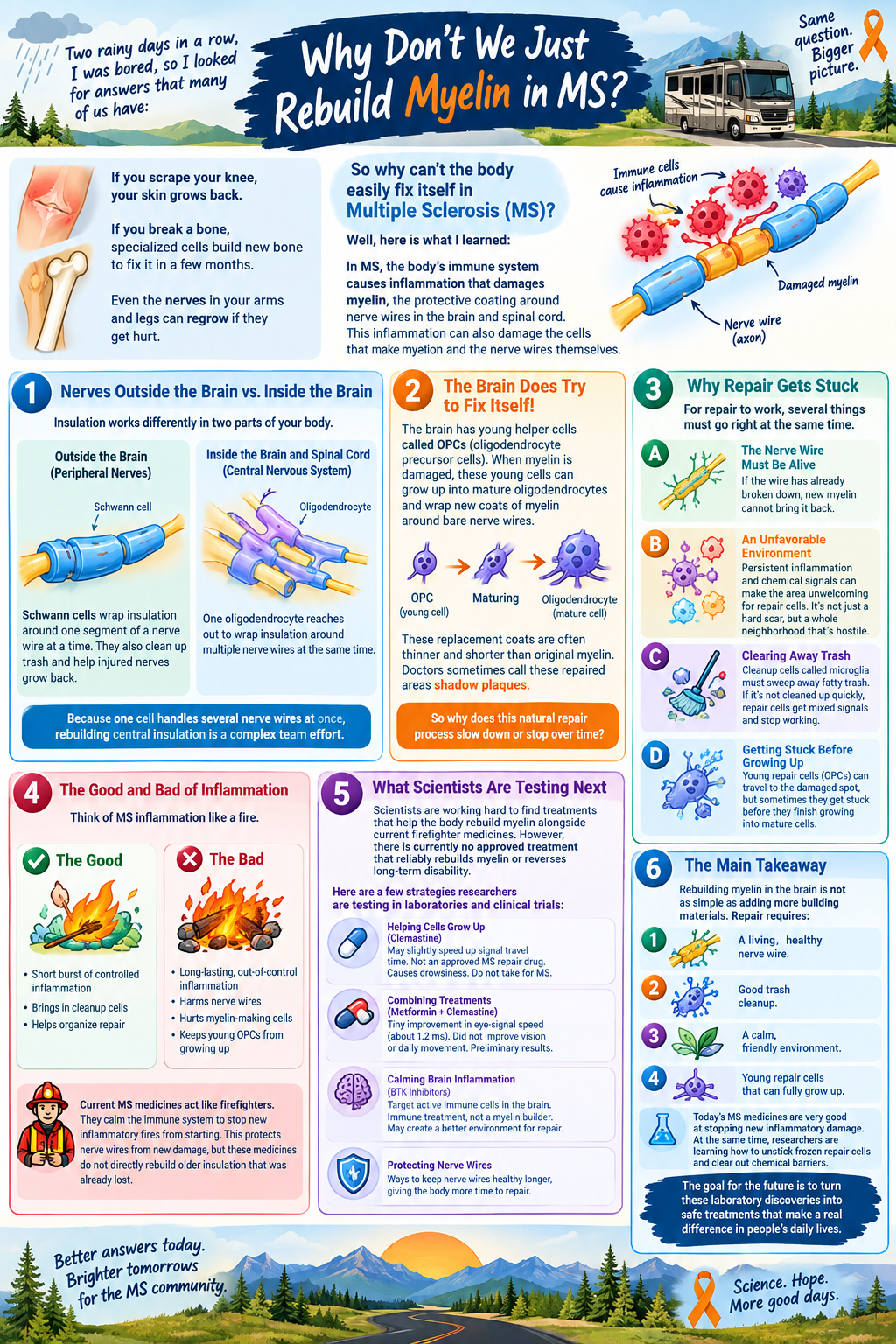
If you scrape your knee, your skin grows back. If you break a bone, specialized cells build new bone to fix it in a few months. Even the nerves in your arms and legs can regrow if they get hurt.
So why can’t the body easily fix itself in Multiple Sclerosis (MS)?
Well, here is what I learned:
In MS, the body’s immune system causes inflammation that damages myelin, which is the protective coating wrapped around nerve wires in the brain and spinal cord. This inflammation can also damage the cells that make myelin and the nerve wires themselves.
The brain can repair some myelin, but it faces special challenges that make complete repair difficult. Here is how it works and why scientists are trying to help.
1. Nerves Outside the Brain vs. Inside the Brain
To understand why repair is tricky, it helps to look at how insulation works in two different parts of your body:
- Outside the Brain (Peripheral Nerves): These are the nerves in your arms and legs. Helper cells called Schwann cells wrap insulation around one segment of a nerve wire at a time. They also clean up trash and help injured nerves grow back.
- Inside the Brain and Spinal Cord (Central Nervous System): Here, myelin is made by cells called oligodendrocytes (oh-lih-go-DEN-dro-sites). Instead of wrapping just one spot, a single oligodendrocyte reaches out to wrap insulation around multiple nerve wires at the same time.
Because one cell handles several nerve wires at once, rebuilding central insulation is a complex team effort.
2. The Brain Does Try to Fix Itself!
It might surprise you to learn that the brain actually tries to repair damage. Early in MS, natural repair happens quite often.
The brain has young helper cells called OPCs (oligodendrocyte precursor cells). When myelin is damaged, these young cells can grow up into mature oligodendrocytes and wrap new coats of myelin around bare nerve wires. These replacement coats are often thinner and shorter than original myelin. Doctors sometimes call these repaired areas shadow plaques.
So why does this natural repair process slow down or stop over time?
3. Why Repair Gets Stuck
For repair to work, several things must go right at the same time:
A. The Nerve Wire Must Be Alive
Rebuilding insulation protects a living nerve wire (also called an axon). If the wire itself has already broken down, new myelin cannot bring it back. Remyelination protects surviving wires, but it cannot fully restore a nerve wire that has been lost.
B. An Unfavorable Environment
After an injury, helper cells try to protect the area. However, persistent inflammation and chemical signals can turn the area into an unwelcoming environment. This makes it hard for repair cells to travel where they are needed. It is not just a hard scar blocking the way, but a whole neighborhood that has become unfriendly to repair.
C. Clearing Away Trash
When myelin is damaged, it leaves behind tiny bits of fatty trash. Cleanup cells called microglia must sweep this trash away. If the trash is not cleaned up quickly, repair cells get mixed signals and stop working.
D. Getting Stuck Before Growing Up
Young repair cells (OPCs) can travel to the damaged spot, but sometimes they get stuck before they finish growing into mature myelin-making cells. Scientists call this maturation arrest.
4. The Good and Bad of Inflammation
Think of MS inflammation like a fire.
- The Good: Right after an injury, a short burst of controlled inflammation brings in cleanup cells to sweep away trash and organize repair.
- The Bad: Long-lasting, out-of-control inflammation harms nerve wires, hurts myelin-making cells, and keeps young OPCs from growing up.
Current MS medicines act like firefighters. They calm the immune system to stop new inflammatory fires from starting. This protects nerve wires from new damage, but these medicines do not directly rebuild older insulation that was already lost.
5. What Scientists Are Testing Next
Scientists are working hard to find treatments that help the body rebuild myelin alongside current firefighter medicines. However, there is currently no approved treatment that reliably rebuilds myelin or reverses long-term disability.
Here are a few strategies researchers are testing in laboratories and clinical trials:
- Helping Cells Grow Up (Clemastine): Scientists tested an old allergy medicine called clemastine to see if it helps young OPCs grow into myelin makers. In small eye-signal tests, it slightly sped up signal travel time along visual nerves. However, this test measures signal speed rather than full visual recovery. Clemastine is not an approved MS repair drug, it causes drowsiness, and people should not take it for MS.
- Combining Treatments (Metformin + Clemastine): In a preliminary study, combining metformin with clemastine showed a tiny improvement in eye-signal speed tests (about 1.2 milliseconds faster). However, it did not improve vision or daily movement over six months. These results are interesting for researchers, but they are preliminary and not ready for everyday care.
- Calming Brain Inflammation (BTK Inhibitors): These experimental medicines target active immune cells inside the brain. They are immune treatments, not myelin builders. If they reduce long-lasting inflammation, they might indirectly create a better environment for natural repair.
- Protecting Nerve Wires: Scientists are testing ways to keep nerve wires healthy for longer, giving the body more time to perform its own repairs.
The Main Takeaway
Rebuilding myelin in the brain is not as simple as adding more building materials. Repair requires:
- A living, healthy nerve wire.
- Good trash cleanup.
- A calm, friendly environment.
- Young repair cells that can fully grow up.
Today’s MS medicines are very good at stopping new inflammatory damage. At the same time, researchers are learning how to unstick frozen repair cells and clear out chemical barriers. The goal for the future is to turn these laboratory discoveries into safe treatments that make a real difference in people’s daily lives.
Resources & Further Reading
To learn more about the biological mechanisms and clinical research discussed in this article, explore the National Multiple Sclerosis Society’s overview on myelin repair and restoring function. Specific clinical studies referenced include the Phase 2 ReBUILD trial on clemastine fumarate published in The Lancet, the CCMR-Two trial protocol evaluating metformin and clemastine at the University of Cambridge, and the National Institutes of Health review on Bruton’s Tyrosine Kinase (BTK) inhibitors in MS.