

The Three Words That Cost More Than They Save
Our Voyage with MS
I have been hearing those three words for over twenty years.
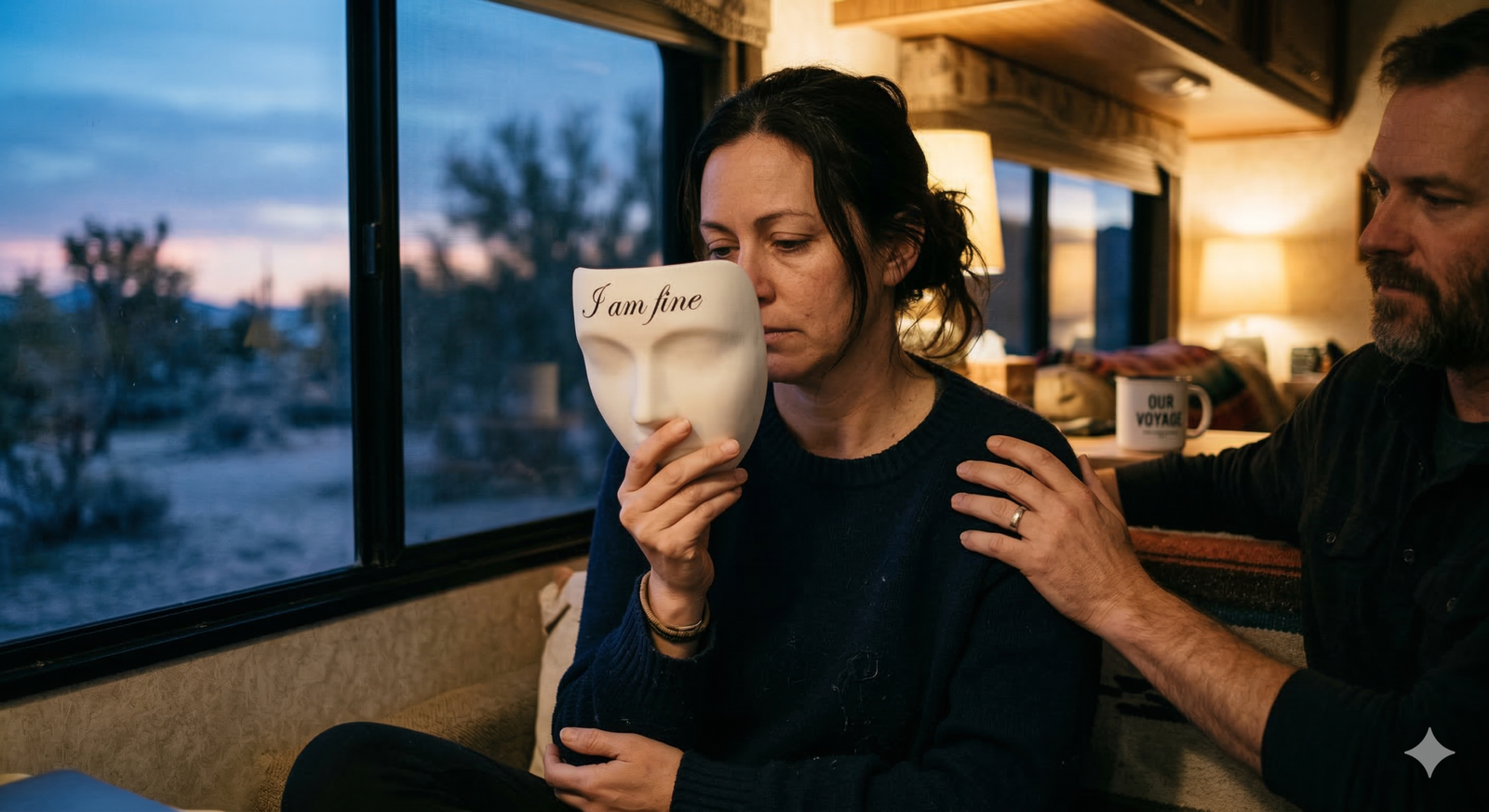
I am fine.
Let me be clear about something right from the start. Those are not words of deception. I am fine is not a lie. It is a verbal mask. A survival mechanism. And understanding what is underneath it changes everything about how a caregiver should respond.
I know what they mean. I also know what they cost. And after two decades as Charlene’s partner and caregiver, I can tell you that those three words, as well-intentioned as they are, never actually save either of us anything.
What Happened Two Days Ago
Charlene was hurting all night. Not a little uncomfortable. Hurting. And she did not wake me up.
She did not wake me up because I need my sleep. Because she did not want to be a burden. Because somewhere in the middle of a painful night, she made a decision for both of us without asking me.
I found out in the morning. And I spent a good part of that morning doing what I would have done at 2am if she had let me. Massaging. Adjusting. Helping her body remember that it is not alone in this.
The night still happened. The pain still happened. The only thing her silence changed was that she carried it alone for hours she did not have to.
We have MS. That is not a tagline. That is a contract. And when she goes through a painful night alone, that contract gets broken. Not out of malice. Out of love. Which somehow makes it harder to address, not easier.
Where It Comes From
I am not angry about it. I understand exactly where it comes from.
What we have come to understand is that the compulsion to say I am fine is rarely rooted in a single motive. It functions as a multi-layered survival mechanism where two things are happening at once. The person is trying to protect their caregiver from the burden. And they are trying to protect their own sense of identity and independence. Both at the same time. So tangled together, you cannot separate them.
The burden protection piece I recognized immediately. When you live with a chronic illness, you become acutely aware of how much your condition affects the people around you. You watch your partner adjust plans, manage logistics, pick up the slack, and show up day after day for something that is never going to be fully fixed. And at some point, the kindest thing you can think to do is take up less space. Ask for less. Protect the people you love from one more thing.
The identity piece is something I had felt but not fully named. Charlene was known as the strong one before the diagnosis. MS did not change who she is. But it changed what her body can do. And saying I am fine is sometimes a way of holding onto the person she was before. Of claiming a default state of normalcy even when her body is doing something else entirely.
I am fine is an act of love and an act of self-preservation at the same time. That is one of the most heartbreaking things about it.
What It Actually Costs
Here is the thing about protecting your caregiver from information they need.
It does not actually protect them.
When Charlene hurts all night and says nothing, she pays the full cost alone. The pain does not split between us just because I am asleep. It lands entirely on her. And in the morning, when I find out, I pay a different cost. The helplessness of knowing she was suffering a few feet away, and I did not know. The wish that she had let me in.
I am fine delays the cost. It does not eliminate it. And it adds something extra on top. Isolation. Because there is a difference between a hard night you go through together, and a hard night one person goes through alone while the other one sleeps.
But here is the part I really want you to sit with.
The MS community talks constantly about how nobody gets it. How outsiders do not understand the fatigue, the pain, the invisible load. How frustrating it is to look fine when you are not. How lonely it feels to live with something the world cannot see.
I hear that. I believe it. And I am going to say something that might sting a little.
I am fine is why they don’t get it.
You cannot ask the world to understand your invisible illness and then hide it from the people closest to you. You cannot want awareness and then hand the people who love you a mask instead of the truth. You trained them. Every time you said I am fine when you were not, you taught the people around you that you were fine. You cannot be surprised that they believed you.
And from a BMSer perspective, it is even more direct than that. I am fine is corrupted data. I cannot manage the system if the system is feeding me false readings. A battery that hides its actual charge level from the operator is not protecting anyone. It is guaranteeing a failure that could have been prevented.
The math never works out in favor of silence. And neither does the system.
What I Want Her to Know
I chose this. I want to be clear about that.
I did not stumble into being Charlene’s caregiver. I walked in knowing her whole story. I married her knowing the MS was part of the deal. I have been here for twenty years, not because I have to be, but because there is nowhere else I would rather be.
Waking me up at 2 am is not a burden. It is the job. It is what I signed up for. It is, in fact, exactly what the BMSer framework is built around. I cannot manage the system if I do not know the system is struggling.
When caregivers proactively check in and create a safe space where asking for help is normalized, it reduces the moral distress on both sides. The guilt of being a burden goes down when the caregiver makes it clear, consistently and without frustration, that showing up for this is exactly what they want to be doing.
I would rather lose two hours of sleep and be useful than sleep eight hours and find out in the morning that she needed me.
The Risk of Being Too Good at This
Here is something I had to reckon with after twenty years of this.
If I get too good at reading Charlene, if I catch every fall before she has to ask, if I anticipate every need before she names it, I might actually be making it easier for her to keep saying I am fine. Because from her side, it is working. The care shows up. The mask stays on. And nothing changes.
There is apparently a name for this. The Groundhog Day loop. I looked that one up, I will be honest. But it fits. Chronic illness already has a way of feeling like the same day on repeat. If the caregiver silently manages everything without ever requiring the mask to come down, the patient never has to face the moment of disclosure. The loop keeps running. The I am fine keeps working. And what was once a coping strategy slowly becomes the only way they know how to relate to the world.
I do not want that for us. And I do not think silence is kindness when it lets the loop run unchallenged.
So I do not just hold space and say nothing. When Charlene says I am fine, I usually just look at her and say two words.
Sure, liar.
No pressure. No lecture. No clinical framework. Just a gentle acknowledgment that I see her, I know the mask, and she does not have to wear it with me. It gets a laugh most of the time. And sometimes, after the laugh, comes the real sentence.
That is the whole goal. Not to force the conversation. Just to leave the door open until she is ready to walk through it.
To Anyone Who Recognizes This
If you are living with a chronic illness, you have probably said I am fine when you were not. Maybe today. We are not here to make you feel guilty about it.
Actually, that is not entirely true. If this made you a little uncomfortable, good. That means it landed where it was supposed to.
Think of I am fine as a placeholder. It is not the real sentence. It is a signal that there is a narrative underneath that needs a safe, non-judgmental space to be told. Your caregiver’s job, and your job, is to build that space together.
If you are holding back to protect the people you love, know this. They did not sign up to be protected from you. They signed up to be with you. All of you. Including the 2 am version. Including the hurting version. Including the version that needs help and does not want to ask for it.
If you are holding back to protect your own sense of who you are, know this, too. Asking for help does not make you the illness. It makes you human. And the people who love you already know the difference.
After twenty years, Charlene still says I am fine sometimes. And I still gently push back. Not because I am keeping score. But because I am fine is a placeholder. And we do better with the real sentence.
Let’s see the world, one charge cycle at a time. 🧡⚡