

How We Manage Medications Full-Time on the Road
Our Voyage with MS
When we sold the house and hit the road full-time in April 2022, we had a long list of logistics to figure out. Mail forwarding. Insurance. Banking. But the one that kept us up at night was simpler and more immediate than any of those.
Where is the next prescription coming from?
Charlene has been managing Multiple Sclerosis since her diagnosis in January 2006. That means a disease-modifying therapy, specialty medications, and a handful of routine prescriptions that do not care whether we are parked at a full-service campground in Florida or dry camping in the Nevada desert 45 miles from the nearest town.
We figured it out. Not all at once, and not without a few white-knuckle moments. But we have a system now, and it works. This is what we learned.
The First Move: Think 90 Days, Not 30
The single most important change we made before we left was converting every routine prescription to a 90-day supply. It sounds simple. It is simple. But it changes everything.
A 30-day prescription means you are always one month away from a problem. A 90-day supply gives you a real buffer. If travel plans shift, if a storm pins you down, if life just does what life does, you are not scrambling. You have time to solve the problem before it becomes a crisis.
Talk to your doctor before you leave. Most will work with you on this. Frame it simply: you are going to be moving and need the flexibility. In our experience, that conversation takes about five minutes and saves enormous stress down the road.
One more thing we started doing even before we went full-time: filling prescriptions early. Most insurance companies and pharmacies allow you to fill up to 3 days before your supply runs out. That means a 30-day prescription can be filled on day 27. A 90-day supply can be filled on day 87. It does not sound like much, but if you do this consistently every single refill, you build a rolling buffer that compounds over time. A few extra days of cushion become a week. A week becomes your safety net when something unexpected happens on the road. Take full advantage of those 3 days every time. Never leave that buffer on the table.
A Quick Note on Controlled Substances
We do not use controlled substances, so we are not going to pretend we have lived experience here. What we can tell you is this: interstate travel with controlled medications is genuinely complicated. Each state has its own regulations, refill restrictions can be significant, and the logistics of keeping a supply consistent while moving across state lines can become a real headache fast.
This is not medical advice. But it might be worth a conversation with your doctor about whether there are alternatives that manage your condition just as well without the interstate complications. And, just speaking practically, without turning you into a zombie behind the wheel of a 40-foot motorhome. That is a conversation worth having before you pull out of the driveway for the last time.
National Chains Are Your Best Friend
When you are stationary, your local pharmacy knows you. When you are moving, you need a pharmacy that moves with you. That means national chains with centralized databases. For us, that is Walgreens, but CVS works the same way. The key is picking one and staying consistent.
Here is the workflow we actually use, straight from the video.
First, turn off autofill. On everything. We know that adds a layer of paying attention to, but autofill and life on the road are not compatible. When a prescription fills automatically at a pharmacy two states behind you, you have a problem. Stay in control of when and where things fill.
For new scripts, the simplest path is to ask your doctor if they can send it directly to whichever location of your chain pharmacy is at your next destination. Just give them the store information, and they call it in there. Done.
If your doctor can only send scripts within your domicile state for whatever reason, here is what we do instead:
- Have them send the script to your home pharmacy in your domicile state. For us that is Florida.
- Put it on hold immediately. Do not let it fill there.
- When you arrive at your next destination, contact the local branch of your chain pharmacy and ask them to pull the script from hold and fill it there.
One practical note: do not rely on pharmacy apps alone to find your nearest location. We have found that the app and Google Maps often disagree on which store is actually closest to where you are parked. Trust Google Maps for proximity and use the app to initiate the transfer.
Specialty Medications: This Is Where It Gets Serious
Routine prescriptions are manageable. Specialty medications are a different level of logistics entirely.
Charlene’s disease-modifying therapy requires overnight shipping, temperature control, and a physical signature on delivery. When you are living in a motorhome that moves every few days, that creates a real problem.
Here is what we learned the hard way: do not have specialty medications shipped to a campground.
Campground mail areas are often unsecured and accessible to any guest. More importantly, many parks have updated their policies to refuse medication deliveries altogether because of liability concerns. Even if a park agrees to accept a delivery, you are taking a risk with something you cannot afford to lose.
Instead, we use secure hold locations. If you happen to be traveling near family or friends, having a delivery sent to a trusted address is always the simplest option. When that is not possible, here is what works.
- FedEx Hold at Location: Have your specialty pharmacy ship to a participating FedEx Office, Walgreens, or Dollar General location. The package is held securely until you pick it up. Worth knowing: Walgreens is one of the most common FedEx hold locations, so even if your specialty pharmacy tells you they do not ship to Walgreens, verify directly with FedEx. Our own specialty pharmacy told us the same thing. They actually do. They talk about the pharmacy, not the FedEx counter.
- UPS Access Points: If your pharmacy ships via UPS, their Access Point network works the same way.
- Know your pickup window: Temperature-sensitive medications typically have a 2 to 3 day hold window. Track your shipment closely. In our experience, these almost always arrive before noon.
One thing that trips people up and tripped us up early: there are two completely different transactions that can happen at a Walgreens, and they happen at two different counters. When your specialty pharmacy ships directly to Walgreens, that goes to the pharmacy counter, just like any other prescription. But when you use Walgreens as a FedEx Hold at Location, that package is not at the pharmacy counter at all. It is at the photo counter, where they keep the FedEx cabinet. If you walk in asking for a package and the pharmacy staff cannot find it, walk to the photo counter. It is probably sitting right there.
Independent Specialty Pharmacies Are Worth Knowing About
Most people default to the big chains for everything. We did too at first. But for specialty medications, independent specialty pharmacies can offer something the chains often cannot: personalized navigation of copay assistance programs.
Manufacturer copay programs and patient assistance foundations exist for many MS medications, and the savings can be significant. A good independent specialty pharmacy will actively work with you to find and apply these programs. The big chains handle too much volume to give that kind of individual attention.
If you hit a wall on cost, especially during open enrollment when formulary changes can cause sudden price spikes, ask your doctor about independent specialty pharmacies in your area or that ship nationally. It is a conversation worth having before you face a crisis.
Open Enrollment: Do Not Let Formulary Changes Catch You Off Guard
Every November, insurance plans can change what they cover and what they charge. If you are on a specialty medication, this can mean a significant price jump with very little warning.
Our three-step response when that happens:
- Review your plan structure. Compare Medicare or private insurance options specifically around your medications, not just your premium.
- Talk to your doctor. There may be therapeutic alternatives that are equally effective and better covered under your current plan.
- Look at copay assistance programs. Your specialty pharmacy or your medication’s manufacturer website is the first place to look.
The through-line in all of this is communication. Between you, your doctor, and your pharmacy. On the road, you do not have the luxury of walking into an office and sorting it out in person. You have to stay proactive and stay in contact.
Bonus: The Shot Glass Hack
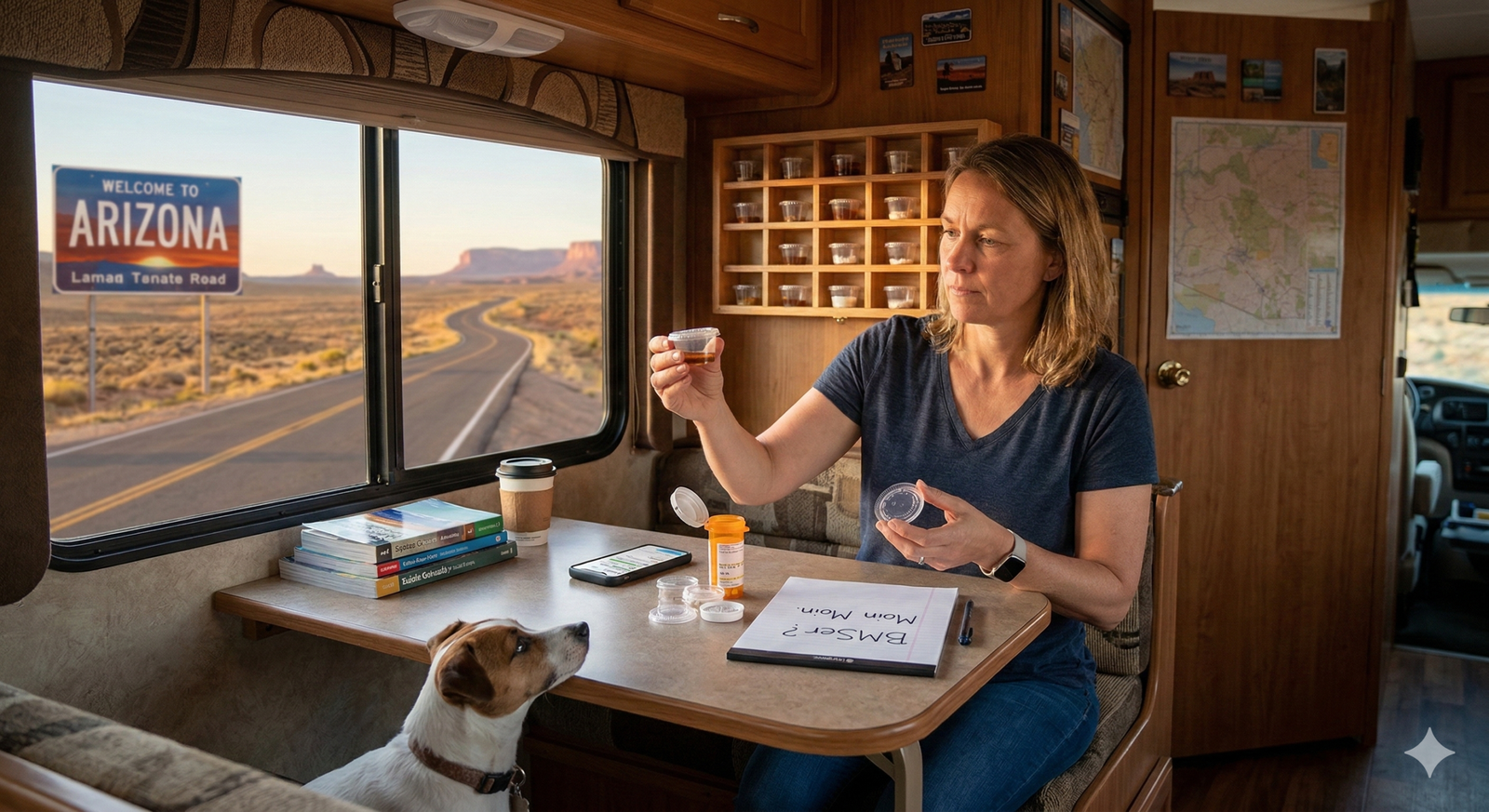
This one came out of a specific problem. Standard pill organizers are difficult to open, easy to spill, and a genuine hazard when you have a dog on board. We needed something that was secure during transit, easy to access, and would not end up all over the floor of Max after a rough stretch of highway.
The solution we landed on: a wall-mounted shot glass display case.
Here is how it works:
- Choose a case with four rows of seven compartments. The seven columns are the days of the week. The four rows are your times of day, morning, afternoon, and bedtime. If you take medications every six hours, that fourth row is yours too. The whole case is one week, laid out by when you take things, not just what day it is. At a glance, you can see whether you took your morning dose or your bedtime dose. Standard pill organizers cannot do that.
- Instead of flimsy plastic lids, use 1-oz portion cups with lids. They are the small, clear cups you see at delis and condiment stations. You can buy them in bulk on Amazon, which is exactly how we do it. And they are reusable, so one order goes a long way. Each day’s dose goes into one cup. Grab it, pop the lid, done. No spills, no fumbling, and if you have a dog on board, nothing ends up on the floor.
- The standard latch on these cases is not built for a moving vehicle. Add a secondary hook or latch to the top of the door. Without it, a bumpy road turns your entire month of medications into a floor-level treasure hunt.
It is not a glamorous solution. It is a practical one. And on a moving home, practical beats glamorous every single time.
The Bottom Line
Managing chronic illness medications from a motorhome is not as complicated as it sounds once you have a system. The system comes down to three things: plan ahead, communicate constantly, and stay flexible.
None of what we described here was handed to us. We figured it out mile by mile, refill by refill, and occasionally the hard way. If something in here saves you one white-knuckle moment on the road, it was worth writing.
If you have a hack that works for you, drop it in the comments. This community runs on shared knowledge.
Let’s see the world, one charge cycle at a time. 🧡⚡