

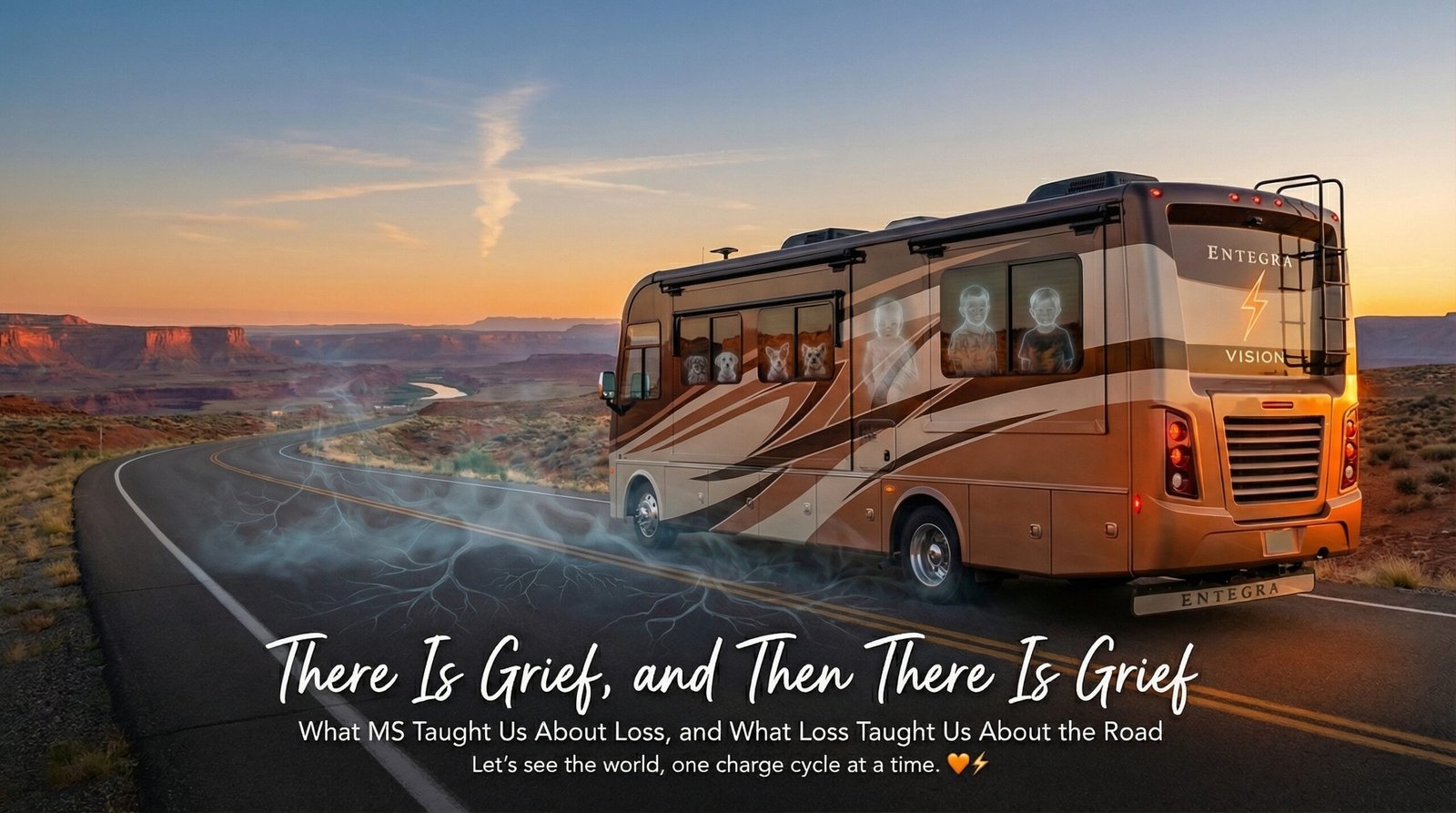
What MS Taught Us About Loss, and What Loss Taught Us About the Road
Our Voyage with MS
When people hear the word grief, they usually think of a funeral. A black suit, a lowered head, a sudden sharp silence. And they are right. That is grief.
But when you live with a chronic illness like Multiple Sclerosis, you learn that grief has a twin. It is the kind that does not arrive with a phone call. It settles in like a slow-moving fog. It lives in the plans that get penciled in instead of inked. In the trip, you had to skip. In the version of yourself you are still learning to let go of.
There is grief, and then there is grief. And to understand the layers we carry today, you have to go back to a time long before Charlene and I ever met.
The First Grief
Before the MS. Before the RV. Before our life together, there was a loss that changed Charlene’s world forever. In February 1992, she lost her first son to SIDS.
It is a loss that defies description. The kind of trauma that leaves a permanent mark on the soul. But we believe it left a mark on her body, too.
Charlene’s MS diagnosis did not come until January 2006. But the timeline tells a story. Science has long explored the link between extreme trauma and the onset of autoimmune disease. When the heart breaks at that level, the nervous system feels every vibration. We believe the unimaginable stress of 1992 was a trigger. That the grief did not just break her heart. It may have quietly rewritten the blueprint of her health.
We cannot prove that. But we believe it. And believing it changes how we carry it.
The Slow Fade
The grief most people associate with chronic illness is what we call the Slow Fade. It is the mourning of the old self that comes with a diagnosis. For Charlene, it is a daily reality. The realization that the mine tour she was excited about is not going to happen. That a simple drive requires two days of recovery. That the body she used to trust now operates on a different set of rules.
That is real loss. Nobody brings flowers for it. Nobody clocks it. But it accumulates.
Here is where we have to be honest. Neither of us grieves the life we left. Not even a little. What we lost was replaced by something we never knew to ask for.
None of this was planned. We met because of a hurricane in 2004 that pushed all the neighbors out into their driveways. Without that storm, we might never have met. Without the MS, we would probably not be doing any of this.
If you had told me in 2004 that we would be living full-time in a motorhome seeing the country, I would have told you that you were out of your mind. I did not even like camping. But the secret we discovered is that this is not camping. This is living.
MS was the catalyst. It closed some doors and pushed us through a different one that led to a life of adventure we never would have found otherwise. We did not choose the road. But the road gave us a freedom we did not know we were looking for.
The Crashing Wave
Then on December 17, 2024, in a campground in Arcadia, the world broke again.
Losing her youngest son was a grief that moved like a hurricane. It turned those weeks into a blur of heartache that reached all the way back to 1992. It was not just a new loss. It was an old foundational wound being ripped open again. The two griefs crashed into each other. And both of them crashed into the MS.
As her caregiver, I had a front row seat to that collision. I was not there in 1992 to hold her hand. But I am here now. And I watched the body remember.
In the weeks after, it was not a clinical flare in the traditional sense. It was a physical manifestation of heartache. The grief sat on her shoulders. It settled into her legs. Her steps got heavier, and it happened more often. Every movement became an act of will. Stress is the fuel MS uses to burn. And when the heart is broken, the nervous system feels every vibration.
The Sound of Weariness
There are moments when the weight of all of this is simply too much. Charlene will look at me and say she just does not want to do this anymore.
To an outsider, those words might sound like giving up. But I know her. What she says and what she means are different things. She is not saying she wants to stop living. She is saying she is exhausted from the fight. That the accumulated grief has stolen her breath, and she needs a moment to just be weak.
In those moments, I do not try to fix it. I hold the space. I know that the woman who survived 1992, survived a diagnosis, and survived December 2024 is still in there. She just needs her system to cool down before she can start the engine again.
What Grief Does When You Let It Move
We did not hit the road, thinking the road would do something for our grief. We just knew we needed to move. And the grief came along for the ride.
Grief that sits still in a stationary life has nowhere to go. It settles into the corners of familiar rooms. It becomes part of the architecture. You stop noticing it the way you stop noticing a wall.
Grief that moves is different. It does not disappear. But it changes shape. It looks out the window. It sees new things. And somewhere on a road you have never driven before, it starts to feel less like weight and more like company.
A year after Arcadia, Charlene chose to be baptized at Harbor Lakes. It was a bridge between the losses and the hope. A quiet declaration that the grief does not get the last word.
Who Travels With Us
We carry everyone we have lost. We carry them on purpose.
Our four dogs who passed, Max, Skully, Lokai, and Jaxon, are part of this voyage too. Jaxon, we had to leave behind physically, in a beautiful spot near Bryce Canyon, where he now runs, where the wild winds roam. That beauty made the goodbye just a little easier. But Max, Skully, and Lokai travel with us in the coach. Their ashes go where we go. None of them have really left.
The people we have lost travel the same way. Not in a box, but in the way you feel someone present in a quiet moment. In the miles that feel heavier than others. In the sunsets that seem to mean something more than just the end of a day.
There is grief for the life we left. There is grief for the people we have lost. They sit in the passenger seat of this RV.
But they do not get to drive.
We keep moving forward. One mile, one victory, one road at a time. Because the voyage continues. And there is still so much world left to see.
Let’s see the world, one charge cycle at a time. 🧡⚡