

How to Research MS Without Losing Your Mind or Your Way
Our Voyage with MS
Twenty years. That is how long we have been living with Multiple Sclerosis. Not observing it from the outside. Living it. Managing it. Researching it. Adjusting to it. Fighting with it and sometimes, on the good days, making peace with it.
In twenty years, we have watched the information landscape around MS change dramatically. When Charlene was diagnosed in January 2006, the internet existed, but the algorithm did not yet own it. You could search for something and mostly find what you were looking for. Research was harder to access but easier to trust because the noise level was lower.
That world is gone. What replaced it is louder, faster, more emotionally charged, and in many ways more dangerous for someone who just got a diagnosis and is sitting at their kitchen table at midnight trying to understand what just happened to their life.
We are not doctors. We are not researchers. We are two people who have been in the MS community long enough to watch people get helped and hurt by the same internet. And we want to talk about something we have started calling the Information Trap.
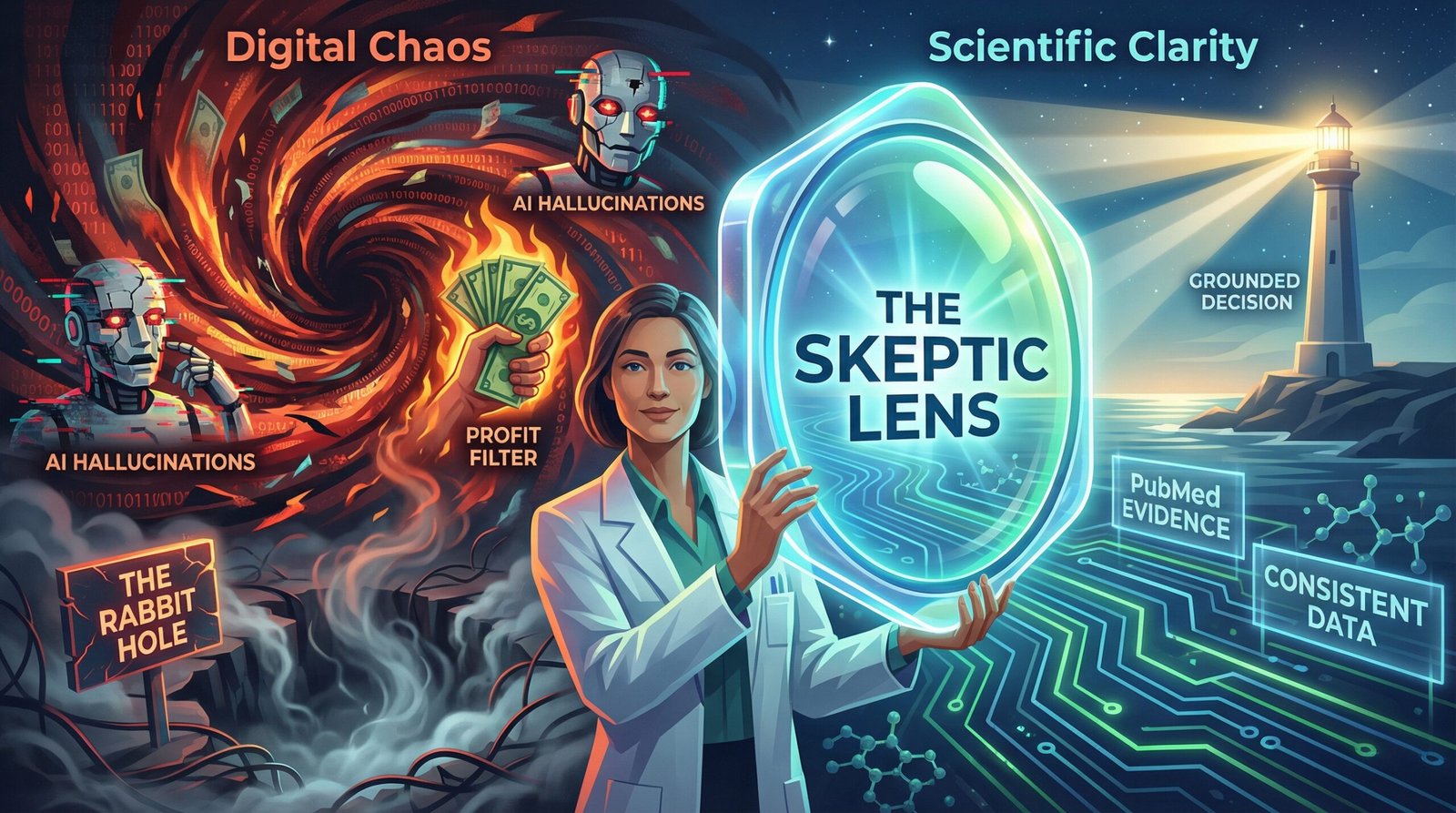
The Rabbit Hole
Whether you were diagnosed yesterday or six years ago, the instinct is the same. Find answers. Understand what is happening. Learn everything you can so you feel less helpless. That instinct is completely natural, and in many ways it is healthy. Being informed about your own condition is part of managing it well.
But the rabbit hole is real. You start with a straightforward search about MS fatigue, and forty-five minutes later, you are reading a forum thread about a supplement stack that someone in Eastern Europe claims reversed their symptoms. You started looking for science and ended up somewhere else entirely. And the scariest part is that you are not sure exactly when the path changed.
This is not a new problem. Misleading health information has always existed. But today it is louder, better packaged, more emotionally targeted, and in some cases powered by artificial intelligence that has no idea whether what it is telling you is true. The volume has increased while the quality control has not kept up.
We have seen what this does to people. We have watched newly diagnosed MSers make decisions based on information that sounded authoritative and turned out to be harmful. We have watched people delay starting disease-modifying therapy because something they read online convinced them their neurologist was wrong. We have watched people spend money they did not have on products that did nothing. And we have watched the guilt that comes after, when they realized they had been misled.
We are not here to tell anyone what to believe or which path to choose. We believe in open-minded, informed decisions. What we want to offer is a set of filters we have developed over two decades that help us tell the difference between information worth trusting and information worth questioning.
Filter 1: The Profit Filter
This is the first thing we look at. Every time. Who is telling us this, and what do they have to gain from telling us?
In twenty years of researching MS, we have never paid a single dollar for information we use to make decisions about Charlene’s care. Not once. The research that matters, the peer-reviewed studies, the clinical trial results, the neurological guidelines, all of it is available for free through legitimate medical libraries and databases.
If you want to do your homework the right way, go where the doctors go. These are the sources we trust:
PubMed (National Library of Medicine): This is the database of record. Free to access, comprehensive, and indexed with peer-reviewed research. If a study is not here, it has not been properly vetted.
The National MS Society (NMSS): They do the hard work of translating complex research into plain English without losing the scientific grounding. No paywall. No agenda beyond the disease itself.
The Cochrane Library: This is the gold standard for systematic reviews. Instead of one study, Cochrane looks at hundreds of studies on a topic to determine what actually works across a large body of evidence. If Cochrane has reviewed a treatment and found it lacking, that matters.
The Big Three Journals: When you see research cited from The Lancet Neurology, JAMA Neurology, or the Multiple Sclerosis Journal, you are looking at work that went through rigorous peer review before it was published. That process is not perfect, but it is accountable.
So when someone tries to charge you for a private PDF that reveals the truth your doctor is not telling you, or a coaching program that offers insider knowledge the medical establishment does not want you to have, that is a signal. Legitimate medicine does not hide things from patients. It publishes them in journals that anyone can read. If a guru or an influencer is the only source of a specific claim, walk away.
The profit filter does not mean free equals trustworthy. There is plenty of bad information available for free. But paid-for exclusive knowledge about a medical condition should always prompt one question: why is this not published where anyone can evaluate it?
Filter 2: Timing Is Not Causation
This one is harder because it sounds like logic. Someone says I did X, and then Y happened. That feels like evidence. It feels like cause and effect. And sometimes it is. But most of the time, especially in a condition as complex as MS, it is not.
We use our own story as the example because it makes the point clearly and because we can laugh about it now. Charlene and I became a couple about nine months before her diagnosis. Her first symptoms showed up roughly six months before we had a name for them. If we only looked at timing, does that mean I caused her MS? Of course not. That is absurd. But that is exactly how human brains work when they are searching for patterns. We find a sequence, and we call it a cause.
This is called correlation, and it is one of the most common traps in health misinformation. Someone stopped eating gluten, and their symptoms improved around the same time. Someone started taking a specific supplement, and their MRI showed fewer new lesions that year. Someone moved to a different climate and felt better. These experiences are real. The conclusions drawn from them often are not.
MS is a relapsing and remitting condition for most people. That means periods of activity and periods of relative calm happen naturally as part of the disease cycle. If you change ten things in your life and then enter a remission period, which of the ten things caused it? The honest answer is probably none of them. But the human brain wants a reason, and it will find one in the calendar.
Personal experience is valuable. We believe that. But personal experience is one data point in a very complex system. When you read someone’s story online, ask yourself whether they controlled for other variables. Ask whether their neurologist agreed with their interpretation. Ask whether their experience has been replicated by anyone else. A single story is the beginning of a question, not the end of one.
Filter 3: Technology Is a Tool, Not a Truth
We need to talk about AI. Not because it is all bad, but because the way most people use it for health research is genuinely concerning, and we do not think enough people understand why.
Why AI Gets It Wrong
Modern AI was built on a breakthrough called Attention. Before this, AI read text linearly, one word at a time. With Attention, AI can connect ideas across massive amounts of text simultaneously. This makes it appear to understand context in a remarkably human way. But it is not understanding. It is pattern matching at an extraordinary scale. Think of it as a hyper-advanced version of your phone’s autocorrect. It predicts what sounds right based on what it has seen before. It is not checking whether what it produces is true.
AI language models are trained on enormous amounts of text from across the internet. That text includes peer-reviewed research. It also includes ten-year-old forum threads, personal blogs, unverified patient testimonials, alternative medicine websites, and heated debates between people with strong opinions and no credentials. The AI does not know which is which. It was not trained to make that distinction. It was trained to produce fluent, confident-sounding responses.
When an AI gives you false information, it is called a hallucination. This is the digital mirror of the human research rabbit hole. The AI follows a trail of patterns and connections from across the internet and stitches them into a story that sounds true but may have no basis in reality. Because the AI is designed for probability rather than proof, it will often tell you what sounds most likely given everything it has read. That is not the same as what is actually true.
A Real Example: Halneuron and the 2009 Promise
We want to give you a concrete example of how this plays out in the real world of MS research.
If you search for nerve pain breakthroughs tonight, an AI or a poorly researched blog might point you toward a drug called Halneuron. It sounds promising. It has neuron in the name. It is described as a non-opioid alternative. You will find phrases like FDA Fast Track and Phase 3 success scattered across the web. Someone who just got diagnosed with MS and is dealing with neuropathic pain could easily walk away from that search feeling hopeful.
Here is the reality. I have been following this specific drug since 2009. Back then, it was being described as coming soon, with an expected release around 2012. Yes, we had high hopes. Today, in 2026, Halneuron is still in Phase 2b trials for chemotherapy-induced pain. It is not an MS treatment. It has never been an MS treatment. And it is not coming soon. Halneuron is Tetrodotoxin, derived from pufferfish toxin. The science behind it is genuinely fascinating. The timeline bears no resemblance to what was being promised seventeen years ago.
The AI does not understand time. It treats a 2009 promise and a 2026 clinical trial with the same level of urgency. It sees nerve pain and Halneuron in its training data and assumes they belong in your conversation. It has no way of knowing that the coming soon promise is older than most smartphones. If an AI or a forum tells you about a breakthrough, find the original source. Check the date. If the promise is older than your current car, it is a rabbit hole, not a reality.
We use AI tools ourselves. They are useful for organizing information, summarizing long documents, and helping us think through questions. But we never use AI as the source of a medical decision. We use it as a starting point for a conversation with Charlene’s neurologist. There is a significant difference between those two things.
Search engines carry a similar problem, amplified by the algorithm. Search engines do not rank results by accuracy. They rank results by engagement. The article that gets the most clicks and the most emotional reaction ranks higher than the article that is simply correct. The system is not designed to help you find the truth. It is designed to keep you clicking.
Use technology. It is not going away, and it has real value. But treat it as a librarian that shows you the shelves, not a doctor that reads the books for you and tells you what they mean.
Filter 4: The Algorithm Check
Social media platforms are built on one goal. Keep you on the platform as long as possible. The most reliable way to do that is to show you content that triggers a strong emotional response. Fear, anger, outrage, and the feeling that you are being kept from something important are among the most effective triggers.
This means that health misinformation travels faster and wider than accurate health information. A post that says your doctors are hiding a cure for MS gets more engagement than a post that explains the nuanced current state of disease-modifying therapy research. The algorithm rewards the first one with more reach. The truth, boring and complicated as it often is, does not perform as well.
These emotions create a real biological response in your brain that makes you more likely to click, share, and stay on the app. When you see a post that makes your heart race or gives you the urgent feeling that everyone is lying to you, you are being biologically manipulated. The Information Trap uses your own anxiety as fuel.
We have developed a simple check we run on anything we encounter in our social media feeds. If a post makes us feel immediate panic, extreme anger, or the urgent sensation that we are being kept from something important by people in power, we slow down. That emotional response is a signal, not a conclusion. It means we are being hooked, and we need to ask why before we react.
Information designed to inform you does not need to manipulate your emotions to make its point. It can show you the evidence and let you feel what you feel. Content designed to mislead you needs the emotional hook first because the evidence is not strong enough to stand on its own. That distinction is worth holding onto.
We know this is a double-edged sword. Healthy skepticism can tip into cynicism that prevents you from engaging with anything at all. That is not what we are asking for. We are asking for a brief pause between the emotional reaction and the action. Ask where this came from. Ask who benefits from you believing it. Ask whether the evidence is being shown to you or just described. That pause is one of the most powerful tools you have.
When the Forum Is the Starting Line, Not the Finish Line
We want to be clear about something. This filter is not telling you to ignore forums entirely. What happened next in our story is proof of why.
Until 2018, Charlene’s pain was managed with opioids. Morphine and Methadone at the same time. We went through pain doctors more often than most people change their bedsheets. The answer from every one of them was the same. Increase the dosage. Her pain level sat at a six or above consistently. That is not quality of life. That is survival. And I knew it had to change.
Here is where it gets contradictory, intentionally. The inspiration came from forums. People talking about personal success using anticonvulsants for neurological pain. Even an antihistamine. The kind of content this entire blog is warning you to question.
But we did not stop at the forum. We used it as a question. I spent a month digging into the research. Not forums. Not blogs. Peer-reviewed research. And I found legitimate scientific backing for using anticonvulsants and SSRIs to treat neurological pain. The forum gave us a lead. The research gave us a foundation.
We brought it to our pain specialist. He dismissed it. The message was clear. Who do you think you are coming to me with this? We moved on. We ended up at USF in Tampa with Dr. Lee, a pain specialist working alongside the MS team. He looked at me after I presented what I had found and said, “You have done your homework.” We made the change together. Within a manageable period of time, Charlene’s consistent pain level dropped from a six and above to a four and below. That is our outcome. We are sharing it as a story, not as medical advice.
That was 2018. A month of research done the hard way. Today, the same depth of research can be done in an hour or two using a tool like NotebookLM, which uses AI to synthesize information from sources you provide. Point it at PubMed studies and peer-reviewed journals, and it becomes genuinely useful. Point it at random internet content, and it gives you random internet conclusions. The tool is only as good as the sources you feed it.
The contradiction is the lesson. Forums are not the enemy. Stopping at the forum is. The algorithm will serve you emotional stories. Being alert, questioning what you find, and fact-checking through legitimate sources can lead to real results. Do your research thoroughly. Then bring it to the right doctor.
Anecdote vs. Data: The Snowflake Problem
MS is sometimes called a snowflake disease. It looks different for everyone. The symptoms Charlene lives with are not the same as the symptoms your neighbor with MS lives with. The treatments that work well for one person may do nothing for another. This is one of the things that makes MS so difficult to research and so easy to misrepresent.
In the MS community online, you will constantly encounter people sharing what worked for them. We are genuinely happy when someone finds something that helps. But a single person’s experience is an anecdote, not data. And there is a meaningful difference between the two.
Clinical trials exist because we need to see how a treatment works across thousands of people, across different disease types, different ages, and different symptom profiles, before we can say it works. When a study reports a result, it is telling you what happened on average across a large, carefully selected group. When one person tells you what happened to them, they are telling you what happened to them. Both pieces of information have value. But they are not the same thing and should not be treated as such.
Never trade a proven treatment plan for someone else’s personal experiment. Use the stories you read online as conversation starters with your neurologist, not as treatment decisions.
Your Best Defense Is Your Own Thinking
We are still researching. We still look things up. We still follow new developments in MS treatment and care because the field moves, and staying informed matters. But after twenty years, we have learned to read the room before we read the article. Halneuron is still on our list.
We check who is telling us something and what they have to gain. We ask whether a personal story is being used as evidence or as an illustration. We verify through sources that have editorial oversight and are accountable for what they publish. We talk to Charlene’s neurologist before we act on anything we find. And we try to hold new information loosely until it has been confirmed by more than one credible source.
None of this is foolproof. We have been misled before. We will probably be misled again. But the filters help. And sharing them is the reason we wrote this.
If you are newly diagnosed or still finding your footing with MS, please know that the instinct to search for answers is the right instinct. Do not stop asking questions. Just get better at asking them about the right sources. Your neurologist. The National MS Society. PubMed. The Cochrane Library. People who have been living this for a long time and have nothing to sell you.
The information trap is real. But the way out of it is not to stop looking. It is to look more carefully.
Let’s see the world, one charge cycle at a time. 🧡⚡