

(Note: Resource links and further reading for this piece can be found at the end of the article.)
As I have frequently pointed out in my previous writings, it is important to understand what disease-modifying therapies, or DMTs, actually do, and what they do not do.
Many MS treatments are especially effective at reducing relapses and preventing new inflammatory lesions in the brain and spinal cord. Some also reduce the risk of disability worsening. But no current treatment completely prevents progression in everyone with MS.
To use a familiar metaphor, relapses are the sudden fires of MS. But what happens when those fires are brought under control, yet the person continues to lose ground?
Take Char’s story, for example.
She has had no recognized relapse since 2014, and her routine MRIs have shown stable results, with no new inflammatory lesions reported. Yet, over those same years, her walking distance steadily decreased. She went from walking miles without assistance to relying on the walls of our RV for balance, then a cane, then a walker, and eventually a mobility scooter.
Her experience raises an important question: How can someone appear stable on an MRI while continuing to lose physical function?
When Stable Scans Do Not Tell the Whole Story
The mismatch between MRI findings and how someone is doing is often called the clinicoradiological paradox. In plain language, what appears on a scan does not always match what a person experiences in daily life. Conventional MRI provides valuable information, but it does not capture every process that can contribute to long-term damage.
One important pattern researchers study is PIRA, short for progression independent of relapse activity.
PIRA describes confirmed disability worsening that occurs outside periods linked to recognized relapses. It can happen even when relapses are well controlled. “Confirmed” matters because researchers distinguish lasting worsening from a temporary change in symptoms.
PIRA describes a pattern, not a single biological cause. It does not tell us exactly why someone’s disability is increasing. It also does not necessarily mean that MRI activity is absent.
Char’s experience illustrates why this research matters. Her story alone cannot establish a PIRA diagnosis or identify the cause of her decline. That requires clinical assessment. But it shows why changes in everyday function deserve attention, even when scans sound reassuring.
Looking Beyond Sudden Attacks
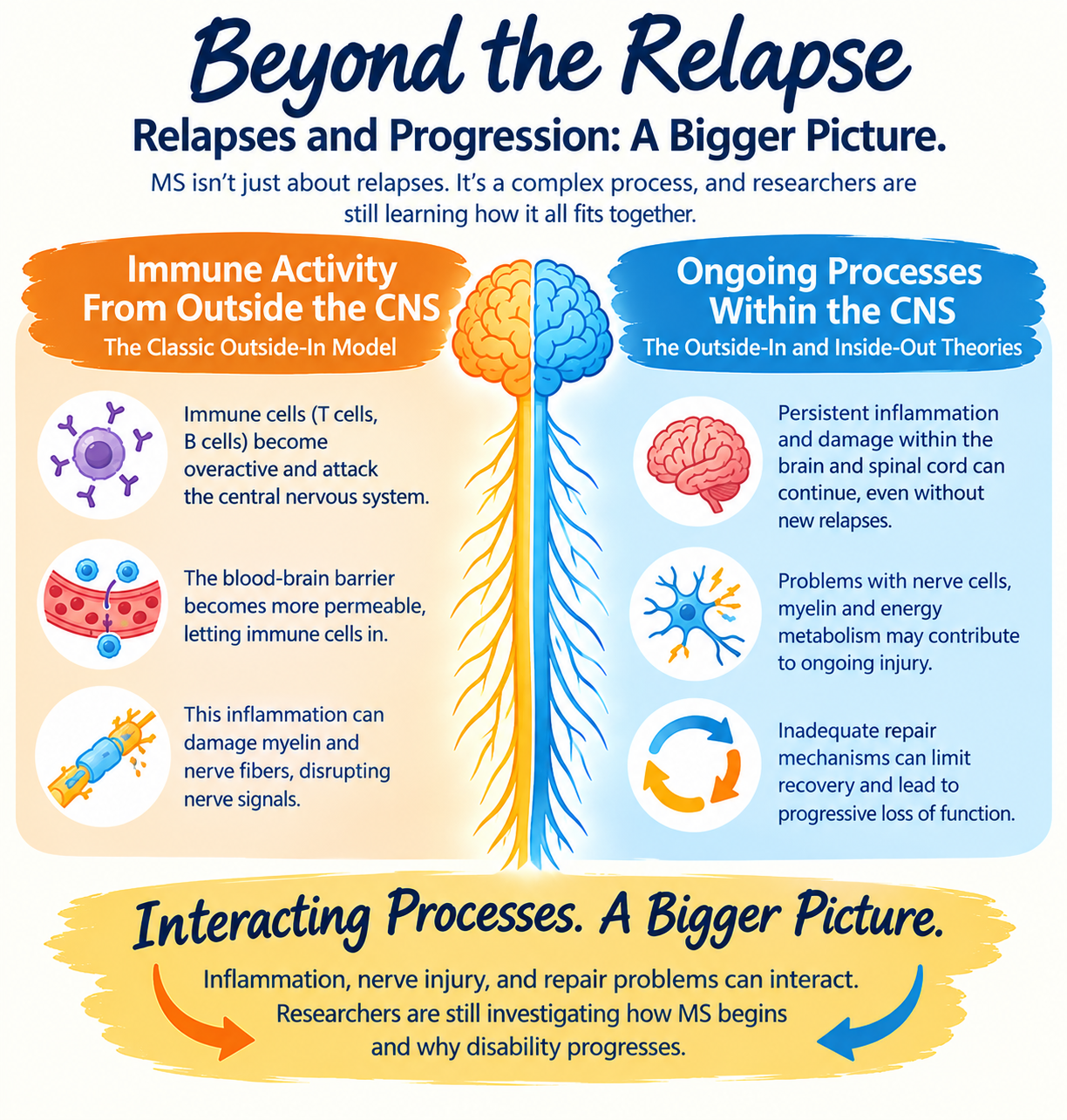
Researchers increasingly recognize that MS progression involves more than the inflammatory attacks that cause recognizable relapses.
Persistent inflammation within the brain and spinal cord, damage to nerve fibers, problems with cellular energy, and inadequate myelin repair may all contribute. These processes can interact rather than operate as separate problems.
Understanding those relationships brings us to a deeper question: How does MS begin, and how does it continue to cause damage?
Three broad frameworks help organize the discussion: the classic “outside-in” model, the proposed “inside-out” model, and an integrated view of interacting processes.
These are not three equally established explanations. MS is widely understood as an immune-mediated disease, while important questions remain about its earliest triggers and the relationship between inflammation and nerve injury.
And let me point out clearly here that I am not going to pick a side. I personally believe that we are not in a position to do that. We have strong theories and strong believers on either side, or both. I encourage you to use this information as a starting point to explore the research for yourself.
The Classic Outside-In Model: The Immune Perspective
The outside-in model places an abnormal immune response near the beginning of the disease process.
Immune cells that normally protect us become involved in an attack on the central nervous system. T cells, B cells, and the substances they produce contribute to inflammation and damage. Disruption of the blood-brain barrier allows immune cells to enter the brain and spinal cord.
One major target of this damage is myelin, the protective coating around nerve fibers. Damage to myelin can interfere with nerve signals. Injury to the nerve fibers themselves can cause lasting loss of function.
What Supports This Model?
The success of immune-targeting treatments provides strong evidence that immune-mediated inflammation plays a major role in MS.
Fingolimod limits the movement of certain immune cells out of lymph nodes. Ocrelizumab targets B cells. These treatments can substantially reduce relapses and new inflammatory lesions.
Some DMTs also reduce disability worsening outside periods linked to relapses. For example, pooled trial data found that ocrelizumab reduced the risk of confirmed PIRA compared with interferon beta-1a. These benefits are important, even though they do not eliminate progression for everyone.
What Remains Unexplained?
Controlling new inflammatory attacks does not necessarily stop every damaging process already underway.
An explanation focused only on new immune attacks from the bloodstream is incomplete. Researchers also study inflammation that persists within the brain and spinal cord, damage left by earlier attacks, and problems with nerve survival and repair.
Continued progression does not disprove an immune-mediated explanation for MS. It shows why an explanation focused only on new attacks by immune cells entering from the bloodstream is incomplete.
The challenge is not simply to prevent the next relapse. It is also to understand and treat the damage that can continue between relapses, or when recognizable relapses are absent.
The Proposed Inside-Out Model: Could Damage Begin Within?
The inside-out hypothesis asks whether changes within the nervous system could sometimes help start the disease process.
Under this proposal, stress or injury affecting myelin, nerve fibers, or the cells that maintain them could occur before a conventional immune attack. Changes in damaged tissue might then help provoke an immune response.
This remains a hypothesis about disease initiation. Observing nerve degeneration does not, by itself, establish that degeneration came first.
Findings Relevant to the Hypothesis
One area of research involves chronic active lesions, sometimes called smoldering lesions.
Studies of chronic active, or “smoldering,” lesions show that inflammation and damage can persist within the brain and spinal cord. Microglia, immune cells that already live within the brain and spinal cord, play an important role. These cells normally help protect and maintain nervous tissue, but persistent activation can contribute to damage. Other immune cells and tissue changes are involved as well.
These findings help explain why controlling relapses may not stop every source of injury. They do not settle the question of how MS first begins.
What Myelocortical MS Revealed
Another important finding came from research led by Dr. Bruce Trapp and colleagues at the Cleveland Clinic.
In a study of 100 donated MS brains, Dr. Bruce Trapp and colleagues identified 12 cases without the usual loss of myelin in the brain’s white matter. These patients still had myelin damage in the brain’s outer layer and spinal cord. The researchers called this pattern myelocortical MS.
The study showed that nerve-cell loss and cerebral white-matter demyelination do not always occur together. It did not establish what started the disease. The 12% proportion also applies to that particular donated-brain cohort, not an established percentage of everyone with MS.
The key questions remain: What starts these changes? Do they precede harmful immune activity, follow it, or develop alongside it? The evidence does not yet establish one universal sequence.
The Integrated View: Interacting Processes
Researchers increasingly study inflammation, nerve injury, and failed repair as connected processes rather than competing explanations.
Immune activity can damage myelin and nerve fibers. Damaged tissue can then change the local environment and sustain further inflammation. These processes may reinforce each other, even while scientists continue to investigate what starts MS.
This framework helps explain how injury might continue even when the acute inflammatory activity responsible for relapses is well controlled.
It does not require us to claim that degeneration always comes first. Nor does it establish that everyone’s disease follows the same path. People with MS experience different mixtures of relapses and gradual worsening. Progressive MS can still involve immune activity.
The research challenge is to identify which processes matter most for each person and determine how to treat them.
What This Means for Treatment
Current DMTs remain important. Their benefits should not be dismissed because they cannot prevent every form of worsening. At the same time, their limits make further research essential.
A major research goal is to combine better control of harmful inflammation with protection of nerve cells and support for repair.
Addressing Chronic Inflammation
Researchers are studying medicines that can reach the brain and affect immune signals involved in ongoing damage. Bruton tyrosine kinase (BTK) inhibitors are one example. Their potential benefits and risks differ, so each medicine must be judged by its own trial results.
Fenebrutinib is one example. In September 2026, the US Food and Drug Administration accepted its application for priority review for relapsing and primary progressive MS. Priority review is a regulatory step, not an approval, and fenebrutinib remains investigational.
In two Phase 3 relapsing MS trials, fenebrutinib substantially reduced annualized relapse rates compared with teriflunomide. In primary progressive MS, the FENtrepid trial met its main goal of showing that fenebrutinib was not worse than ocrelizumab by more than a prespecified margin on the study’s disability-progression measure.
However, the recent withdrawal of the New Drug Application for another BTK inhibitor, tolebrutinib, illustrates the immense regulatory hurdles these treatments face. Sanofi withdrew its application in the US for non-relapsing secondary progressive MS (nrSPMS) following a Complete Response Letter from the FDA.
The FDA’s decision came down to a strict risk-benefit calculation. The agency noted a substantial risk of severe drug-induced liver injury with tolebrutinib, including cases requiring transplantation. At the same time, regulators determined the drug’s clinical benefit was too uncertain in the truly “non-active” MS population. The group with the greatest unmet need. According to a published account of the FDA’s assessment, the agency considered the benefit to be driven largely by the approximately 12.5% of participants with gadolinium-enhancing lesions at baseline. It also noted that approved treatments for active SPMS do not carry the same magnitude of liver-injury risk. Furthermore, the separate PERSEUS trial in primary progressive MS failed to meet its main endpoint, so it did not establish a disability-progression benefit in that population.
Safety matters as much as effectiveness across this entire class of drugs. Fenebrutinib has also shown liver-safety signals, including a Hy’s Law case that was asymptomatic and resolved after treatment discontinuation. Its trials have also reported a numerical imbalance in deaths from varied causes, including infections and bleeding. These findings require careful benefit/risk assessment. These medicines are not interchangeable, but they will all face intense scrutiny to prove their benefits definitively outweigh their unique risks.
Protecting Nerves and Supporting Repair
Other experimental approaches aim to support nerve-cell energy use or help the brain repair myelin. Researchers still need to establish which approaches produce meaningful, lasting benefits for people with MS.
Remyelination means forming new myelin around nerve fibers that have lost it. Researchers are studying treatments that might encourage this process, support nerve-cell survival, or improve how nervous tissue produces and uses energy.
Two investigational approaches have attracted interest, although they target different processes.
PIPE-307 was studied as a potential treatment to promote remyelination. However, in November 2025, it was reported that its Phase 2 VISTA trial did not meet its prespecified primary or secondary efficacy endpoints. It is an important example of why promising biology does not always translate into measurable clinical benefit.
CNM-Au8 is being investigated for effects on cellular energy metabolism and possible neuroprotection. Findings of interest do not yet establish that it can reliably rebuild myelin, restore lost function, or prevent disability progression.
These examples show why promising biology must be tested in clinical trials that measure meaningful benefits for patients.
Will Combination Treatment Be the Answer?
One research direction is to combine approaches that address different parts of MS.
A treatment might reduce inflammatory activity while another protects nerve cells or supports myelin repair. This is a reasonable goal, but it is not an established universal solution.
Researchers must determine which approaches work, which patients benefit, how treatments interact, and whether the benefits outweigh the risks.
The goal is not simply to add more medicines. It is to identify the processes driving disability and treat them effectively and safely.
Looking Beyond the Relapse
For people living with MS, the absence of relapses and new inflammatory lesions is good news. It can show that important aspects of disease activity are being controlled.
But it does not tell the whole story.
Char’s experience reminds us that stable MRI results and the absence of recognized relapses do not always mean that physical function will remain unchanged. The changes we see in everyday life matter, too.
We should recognize what existing treatments have achieved while remaining honest about their limits. We should welcome new ideas without confusing promising theories with proven facts.
For us, the message is simple: No relapse does not necessarily mean no progression. A stable MRI is an important part of the picture, but it is not the whole picture.
And that is why the evolving science of MS deserves our attention.
Article Sources and Further Reading
These resources provide background for “Beyond the Relapse: The Evolving Science of Multiple Sclerosis.” Some are peer-reviewed research papers, while others are regulatory news reports or company announcements. The descriptions identify those differences so readers can judge the evidence in context.
Understanding Progression and Current Treatments
- Does Ocrelizumab Limit Multiple Sclerosis Progression? Current Evidence from Clinical, MRI, and Biomarker Data
A peer-reviewed review of ocrelizumab’s effects on disability progression, including progression independent of relapse activity, or PIRA. It helps explain why current treatments should not be described as addressing relapses alone. Free full text. pmc.ncbi.nlm.nih - Multiple Sclerosis: Molecular Pathogenesis and Therapeutic Strategies
A detailed scientific review of the biological processes involved in MS. It provides background on immune activity, nerve injury, and treatment research, helping readers understand why inflammation and degeneration are studied together. Technical reading. nature - The Role of Glial Cells in Chronic CNS Inflammation
A peer-reviewed review explaining how microglia and other support cells can contribute to persistent inflammation within the brain and spinal cord. Useful background for the article’s discussion of ongoing tissue damage. Free full text. pmc.ncbi.nlm.nih
Myelocortical MS
- Cortical Neuronal Densities and Cerebral White Matter Demyelination in Multiple Sclerosis: A Retrospective Study
The original peer-reviewed study behind the myelocortical MS discussion. Researchers identified 12 cases among 100 deceased people with MS that lacked cerebral white-matter demyelination but still had demyelination in the cortex and spinal cord. The link opens the study’s PubMed record and abstract: pubmed.ncbi.nlm.nih - Myelocortical Multiple Sclerosis: Neurodegeneration Without White Matter Demyelination
Cleveland Clinic’s explanation of the study and its significance. This is a more approachable companion to the original research paper and clarifies where demyelination was and was not found. consultqd.clevelandclinic
BTK Inhibitors and Chronic Inflammation
- Bruton’s Tyrosine Kinase Inhibitors in Multiple Sclerosis
A peer-reviewed review of BTK inhibitors, including their proposed mechanisms, clinical trial findings, and safety concerns. Useful for understanding why individual drugs must be evaluated separately, particularly regarding liver safety. Technical reading; full-text access may vary. link.springer - FDA Accepts Fenebrutinib NDA Under Priority Review for Relapsing and Primary Progressive MS
A medical news report covering the September 2026 regulatory announcement and major Phase 3 findings. It provides context for the distinction between priority review and approval, and between non-inferiority and superiority. neurologylive - Roche Presents New Pivotal Trial Data Across Broad Multiple Sclerosis Population
Roche’s October 21, 2026 announcement reporting additional fenebrutinib analyses, including findings related to chronic lesion activity. This is a manufacturer announcement, not an independent review or a substitute for a full peer-reviewed publication.roche - Tolebrutinib Liver Safety: A Detailed Overview
A journal article discussing tolebrutinib’s liver-safety findings and clinical development. It also provides context for the differing results across relapsing, nonrelapsing secondary progressive, and primary progressive MS studies. msard-journal
Myelin Repair and Cellular Energy Research
- Contineum Therapeutics Reports Topline Data From Its Phase 2 PIPE-307 VISTA Trial
The developer’s announcement that PIPE-307 did not meet the trial’s prespecified primary or secondary efficacy endpoints. This is an important example of why a promising repair mechanism does not necessarily produce measurable clinical benefit. Manufacturer-reported results.contineum-tx - VISIONARY-MS Top-Line Results: A Phase 2 Study of CNM-Au8
A scientific meeting abstract published in Neurology reporting early clinical findings for CNM-Au8. It provides context for research on cellular energy support and potential neuroprotection, but should not be read as proof that the treatment restores myelin or prevents disability. A conference abstract provides less detail than a full research paper. neurology
A Note About These Sources
The research papers explain what investigators have observed and how they interpret those findings. News reports and manufacturer announcements can provide timely updates, but their claims should be weighed alongside full trial publications and regulatory assessments.
This list supports an educational article. It is not a recommendation to start, stop, or change an MS treatment.