

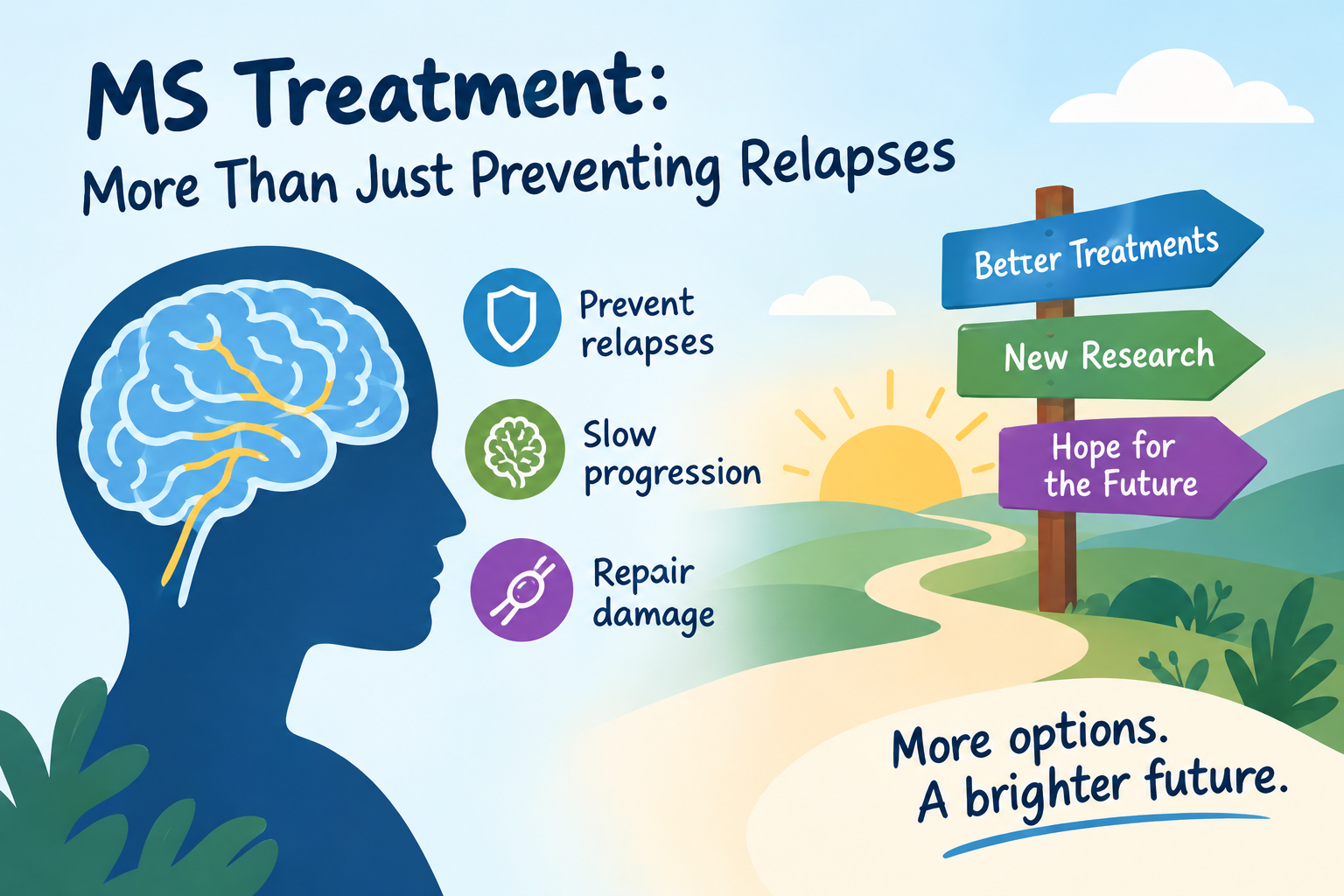
I recently made a statement in a Facebook comment: Do not confuse how traditional Disease-Modifying Therapies (DMTs) work. DMTs were primarily developed to reduce relapses and prevent new active lesions.
These medicines were mainly developed to reduce relapses and prevent new areas of damage in the brain and spinal cord. They were not originally designed to stop all forms of MS progression or repair old damage.
To understand what these medicines can and cannot do, we need to look at relapses, progression, and research into repairing damage.
1. The Hidden Reality of MS Progression (PIRA)
For many years, doctors looked at MS mainly in terms of relapses. A relapse happens when new symptoms appear, or old symptoms worsen because of new inflammation in the brain or spinal cord. Some symptoms improve as the inflammation settles, although recovery may not be complete.
But researchers and people living with MS noticed something else. Many people continued to get worse slowly, even when they had no relapses and no new active spots on their MRI scans.
Researchers call this Progression Independent of Relapse Activity (PIRA). In simple terms, it means MS can cause a person to get worse even when they are not having relapses.
Think of relapses as sudden fires. PIRA is more like a slow, hidden burn that continues in the background.
Scientists believe several processes may contribute to PIRA. These include inflammation that stays trapped inside the brain and spinal cord, overactive immune cells, damage in the brain’s outer layer, and the loss of nerve cells and their fibers over time.
Researchers are still working to understand exactly how these processes work together.
Why the Location of Brain and Spinal Cord Damage Matters
When Char was diagnosed, her neurologist counted at least 24 lesions. A lesion is an area of damage that can show up on an MRI scan. He was not an MS specialist, but he told us it was the most lesions he had ever seen.
When we joined two local MS self-help groups, we met other people living with MS. Lesion counts sometimes became an informal competition. Char could easily win by the numbers, but some people with fewer lesions were already using wheelchairs.
When we spoke with our new neurologist, we learned something important: the number of lesions does not tell the whole story. Where those lesions are located also matters.
Doctors call the mismatch between MRI findings and a person’s symptoms the clinicoradiological paradox. That’s a complicated name for a simple idea: what an MRI shows does not always match how much MS affects someone’s life.
For example, a person may have 20 or 30 lesions in parts of the brain where other nerve pathways can sometimes help work around the damage. That person may still be able to walk.
Another person may have only three to five lesions, but one could be in the brainstem or spinal cord. These areas carry important messages between the brain and the body. Damage in a critical spot can have a much bigger effect on movement and other body functions.
This is why preventing new lesions still matters. A new lesion in the wrong place could cause serious problems. DMTs can lower the risk of new inflammatory damage, including damage to important nerve pathways.
But preventing new lesions is only part of the picture. It does not necessarily stop the slow worsening that can happen through PIRA.
2. Early Injectable Medicines/DMTs and Dr. Ebers’ Criticism
The first widely used DMTs arrived in the 1990s. Many were medicines people had to inject. These included interferon beta medicines such as Betaseron, Avonex, and Rebif, as well as glatiramer acetate, sold as Copaxone.
In a major two-year Betaseron study, people taking the higher dose had about one-third fewer relapses per year than people taking a placebo. The study did not show a clear difference in disability during that time. You can read the study link in the comments below.
However, not everyone was convinced that reducing relapses meant these medicines would prevent long-term disability.
One of the most well-known critics was Dr. George C. Ebers, a professor of clinical neurology at the University of Oxford and a leading MS researcher. He was involved in early research on interferon beta-1b and later studies that followed people with MS over many years.
Dr. Ebers was also a lead investigator in the London, Ontario Natural History Study. This study followed 1,044 people with MS for an average of 25 years. The link to this study is in the comments below.
His work raised several important questions about how researchers studied MS treatments:
- Relapses do not tell the whole story: The number and severity of a person’s early relapses did not closely predict when that person would develop progressive disability or reach important milestones, such as needing a cane.
- Short trials cannot answer every long-term question: Many early drug trials lasted about two years. Researchers often measured how many relapses people had or how many new lesions appeared on MRI scans. Those results were useful, but they could not reliably tell researchers how disabled a person might become 10 or 20 years later.
- The long-term benefits remained uncertain: Dr. Ebers argued that the evidence showing that early injectable treatments changed the long-term course of MS was limited and unclear.
What Was Dr. Ebers Really Saying?
In online MS discussions, his work is sometimes used to claim that DMTs do not help or that people should avoid treatment. That is not the same as what his research questioned.
Dr. Ebers was skeptical of claims that the early treatments could prevent long-term progression. He argued that the evidence for those benefits was limited or uncertain. His criticism focused on the difference between reducing relapses in the short term and protecting the brain and spinal cord over the long term. These are two different goals.
DMTs can reduce relapses and lower the risk of new inflammatory lesions. Those benefits matter because new damage can affect important nerve pathways.
But preventing relapses does not automatically mean a treatment will stop all the other processes that can cause MS to progress. Understanding this difference helps us see why relapse prevention and research into protecting and repairing the nervous system are both important.
3. The Second and Third Generations: Better Relapse Control and New Targets
As researchers learned more about MS, they developed treatments that worked in different ways and often reduced relapses more strongly.
More Treatment Choices: New Options in the 2000s and 2010s
This period brought more treatment choices, including Natalizumab (Tysabri), Fingolimod (Gilenya), Teriflunomide (Aubagio), and Dimethyl fumarate (Tecfidera).
These medicines work in different ways. In clinical trials, the reduction in relapses ranged from about 31% for teriflunomide to about 68% for natalizumab.
These numbers come from different studies. The studies included different people and sometimes used different comparison treatments, so the percentages are not a head-to-head comparison.
By reducing relapses, these treatments also reduce opportunities for disability to worsen because of relapses. Researchers call this relapse-associated worsening, or RAW.
However, a treatment that reduces relapse-related worsening may not prevent every other cause of disability.
B-Cell Treatments and Treatments for Progressive MS: More Targeted Treatments
From the late 2010s onward, treatments that target specific immune cells became an important part of MS care.
Examples include medicines that target B cells, a type of white blood cell involved in the immune system. These treatments include Ocrelizumab (Ocrevus), Ofatumumab (Kesimpta), and Ublituximab (Briumvi).
Other medicines, such as siponimod (Mayzent), were developed for particular forms of MS. Mayzent has been shown to reduce the risk of disability progression in people with active secondary progressive MS.
These treatments represented important advances. For example, the ORATORIO trial studied Ocrevus in primary progressive MS, while the EXPAND trial studied Mayzent in secondary progressive MS. Both trials found that treatment reduced the risk of confirmed disability progression compared with placebo. A placebo is a treatment that does not contain the active medicine being tested. The study links can be found in the comments below.
Why Is Progression Still So Difficult to Stop?
One challenge is that many treatments work mainly on immune cells outside the brain and spinal cord.
The brain and spinal cord are protected by a barrier called the blood-brain barrier. Think of it as a security checkpoint that controls which substances can pass from the blood into the central nervous system.
Large medicines, including many antibody treatments, have limited ability to cross this barrier. As a result, they mainly affect immune activity outside the brain and spinal cord.
But some of the inflammation linked to ongoing MS progression may happen inside the central nervous system itself.
Scientists are studying immune cells that remain active in the brain and spinal cord, including B cells and cells called microglia. Microglia normally help protect and maintain brain tissue, but when they stay overactive, they may contribute to damage.
This is one reason researchers are looking for treatments that can reach the central nervous system and affect these processes more directly. It is an important area of research, but scientists have not yet solved every part of the problem.
4. The Next Frontier: New Treatments and Myelin Repair
Researchers are now studying treatments designed to reach the brain and spinal cord more easily. They are also looking for ways to repair damage that has already happened.
BTK Inhibitors
One group of medicines being studied is called Bruton’s tyrosine kinase inhibitors, or BTK inhibitors. These medicines block a protein involved in how certain immune cells work. Researchers hope that some BTK inhibitors may help control immune activity both in the blood and inside the brain and spinal cord.
Not all BTK inhibitors reach the central nervous system to the same degree. Two examples being studied for MS are tolebrutinib and fenebrutinib.
Tolebrutinib was designed to enter the central nervous system. Researchers hope that medicines like this may help control immune activity inside the brain and spinal cord, including activity involving microglia and other immune cells.
An important result came from the Phase 3 HERCULES study. In HERCULES, tolebrutinib lowered the risk of disability worsening that lasted at least six months by 31% compared with placebo. The study link is available in the comments below.
During the study, about 23 out of 100 people taking tolebrutinib had this lasting worsening, compared with about 31 out of 100 taking placebo. This does not mean that each person’s MS became 31% better.
This was an important finding because the study showed a delay in confirmed disability progression in a group of people whose MS was progressing without relapses.
The result supports further research into treatments that act inside the brain and spinal cord. But this trial alone cannot show exactly which cells or processes caused the benefit.
Liver problems were an important safety concern in the tolebrutinib research and require careful monitoring.
Can We Repair Damage That Has Already Happened?
This is another major question in MS research.
Myelin is the protective covering around nerve fibers. Think of it like the insulation around an electrical wire. When myelin is damaged, messages traveling along the nerve may slow down or fail to get through properly.
The body can sometimes repair damaged myelin. This process is called remyelination.
But there is an important limit: the nerve fiber itself must still be alive and intact enough for the repair to help. If the nerve fiber has been badly damaged or lost, adding new myelin cannot bring that missing nerve pathway back.
Long-lasting MS lesions can also develop scar-like changes that make repair more difficult. These changes can interfere with the cells that normally produce myelin.
Researchers have tested metformin and clemastine together as a possible way to help repair myelin. Early results suggest a small benefit on tests linked to myelin repair. They have not yet shown that the combination improves disability.
Safety is also important. A separate study in people with progressive MS stopped testing clemastine after some participants worsened faster.
People should not try these medicines on their own to repair MS damage. These approaches are still being studied. They are not established treatments for repairing MS damage in routine clinical care.
The hope is to protect surviving nerve fibers, improve the conditions around damaged areas, and help repair cells do their job.
5. Beyond Traditional DMTs: CAR-T Cell Therapy and Jan’s Story
For people whose MS continues to progress despite current treatments, researchers are exploring other ways to change how the immune system works.
One approach is called CAR-T cell therapy. It is an experimental treatment that changes a person’s T cells, which are immune cells, so they can recognize and attack specific targets.
In a typical CAR-T treatment, T cells are collected and changed in a laboratory. The modified cells are then given back to the patient.
Some CAR-T treatments use a person’s own cells. Others use cells from a donor that have been prepared for use in another person. The treatment discussed here, azer-cel, targets a marker called CD19 on B cells.
Researchers are interested in CAR-T therapy because these living cells may be able to reach parts of the central nervous system that some other treatments cannot reach as easily.
Scientists are studying whether CAR-T cells could affect harmful B cells both in the blood and inside the brain and spinal cord. One hope is that this could help address some of the processes linked to PIRA.
This is still an area of active research. Scientists do not yet know whether CAR-T therapy will prove safe and effective for MS or how much it might help with progression.
Following Jan’s Journey First-Hand
Jan Janisch-Hanzlik was the first person with MS in the world to receive an off-the-shelf donor CAR-T treatment in a clinical trial. The treatment is called azercabtagene zapreleucel, also known as azer-cel.
Rather than relying only on information about Jan from other people, I encourage readers to follow her own account of the experience. Jan regularly shares her story, daily reflections, and updates about her clinical trial on her Facebook page, MS with Moxie. Follow her page at https://www.facebook.com/mswithmoxie.
Her posts give readers a first-hand view of what it is like for one person with MS to take part in a trial involving a new type of treatment.
Her experience is one person’s journey. It cannot tell us by itself whether the treatment will work for other people or what the results of future studies will show.
Understanding the Risks
CAR-T cell therapy can cause serious side effects.
One risk is cytokine release syndrome, or CRS. This happens when the immune system releases a large amount of signaling chemicals and causes a strong reaction throughout the body.
Another risk is damage to the nervous system, sometimes called neurotoxicity.
Patients may also need chemotherapy before the CAR-T treatment. This helps prepare the body for the modified cells but brings its own risks.
These treatments require careful medical supervision and monitoring.
As with any treatment, possible benefits must be weighed against possible harms. For people whose MS continues to progress, clinical trials may be an option to discuss with an MS specialist. A trial is not a guarantee of benefit, and the risks and requirements need to be understood before joining.
6. A New Medicine Being Studied: PTD802
While doing research, I found another experimental medicine that scientists are studying.
Researchers are looking for ways to help the body repair myelin. As explained earlier, myelin is the protective covering around nerve fibers. When MS damages this covering, nerve signals may have trouble traveling through the brain and spinal cord. Repairing myelin is called remyelination.
One experimental medicine being studied for this purpose is called PTD802. It is being developed by a company called Pheno Therapeutics.
PTD802 blocks a protein in the body called GPR17. Scientists think this protein acts like a brake on some of the cells that help make myelin.
Researchers hope that blocking GPR17 will help young myelin-making cells finish developing so they can make myelin. The idea is promising, but there is still a lot to learn.
In January 2025, health authorities in the United Kingdom approved an early human study of PTD802. In June 2026, the U.S. Food and Drug Administration (FDA) allowed an early study to begin in the United States.
These early studies focus mainly on safety, side effects, and how the body absorbs and processes the medicine. They are called Phase 1 studies, an early step in testing a new medicine in people.
The announced study in healthy volunteers is not designed to show whether PTD802 helps people with MS.
PTD802 is still experimental. It is not an approved treatment for MS, and scientists do not yet know whether it will help people living with the disease. It is worth keeping an eye on as research continues.
Learn More About PTD802
The links to Pheno Therapeutics’ U.S. and UK study announcements and the MS Society’s explanation of PTD802 can be found below.
7. Conclusion: A New Era of Understanding
Preventing relapses remains an important part of MS treatment. DMTs can lower the risk of new inflammatory damage to the brain and spinal cord, including damage in areas that control important body functions.
But we also need to understand that MS can continue to get worse even when relapses are under control.
Researchers are working to understand PIRA and find better ways to slow or stop this ongoing progression. They are studying medicines that can reach the brain and spinal cord more easily, treatments that change how immune cells work, and new ways to repair damaged myelin.
CAR-T cell therapy and experimental medicines such as PTD802 are also part of this expanding research. They offer new questions to explore, but they have not yet been proven to repair MS damage or stop progression in people with MS.
The important point is that MS research is moving beyond the goal of preventing relapses alone. Scientists are working toward better ways to protect nerve cells, slow progression, and repair damage where possible.
There is still much to learn. Research results need to be tested and confirmed, and promising early findings do not always lead to successful treatments.
A Note About Safety
All DMTs can have side effects and risks. Talk with an MS specialist about the possible benefits and risks before starting treatment. Regular follow-up and monitoring are important while taking these medicines.
If you experience new or worsening symptoms, signs of infection, fever, changes in vision, a severe headache, a rash, or another unexpected change while taking a DMT, contact your healthcare team promptly. Seek emergency care for severe or life-threatening symptoms.
Open communication between people living with MS and their healthcare teams is essential for making informed treatment decisions and using medicines safely.
Links to Include in the Comments Section:
Betaseron Phase 3 Study: https://pubmed.ncbi.nlm.nih.gov/8469318/
London, Ontario Natural History Study: https://academic.oup.com/brain/article-abstract/123/3/641/348835
ORATORIO Trial (Ocrevus in PPMS): https://www.nejm.org/doi/full/10.1056/NEJMoa1606468
EXPAND Trial (Mayzent in SPMS): https://www.thelancet.com/journals/lancet/article/PIIS0140-6736(18)30475-6/fulltext
HERCULES Study (Tolebrutinib in nrSPMS): https://www.nejm.org/doi/full/10.1056/NEJMoa2415988
Follow Jan’s Journey at MS with Moxie: https://www.facebook.com/mswithmoxie
MS Society UK Explanation of PTD802: https://www.mssociety.org.uk/research/explore-our-research/emerging-research-and-treatments/explore-treatments-in-trials/ptd802
Pheno Therapeutics UK Clinical Trial Announcement: https://phenotherapeutics.com/category/clinical-trials/
Pheno Therapeutics FDA IND Clearance Announcement: https://phenotherapeutics.com/