

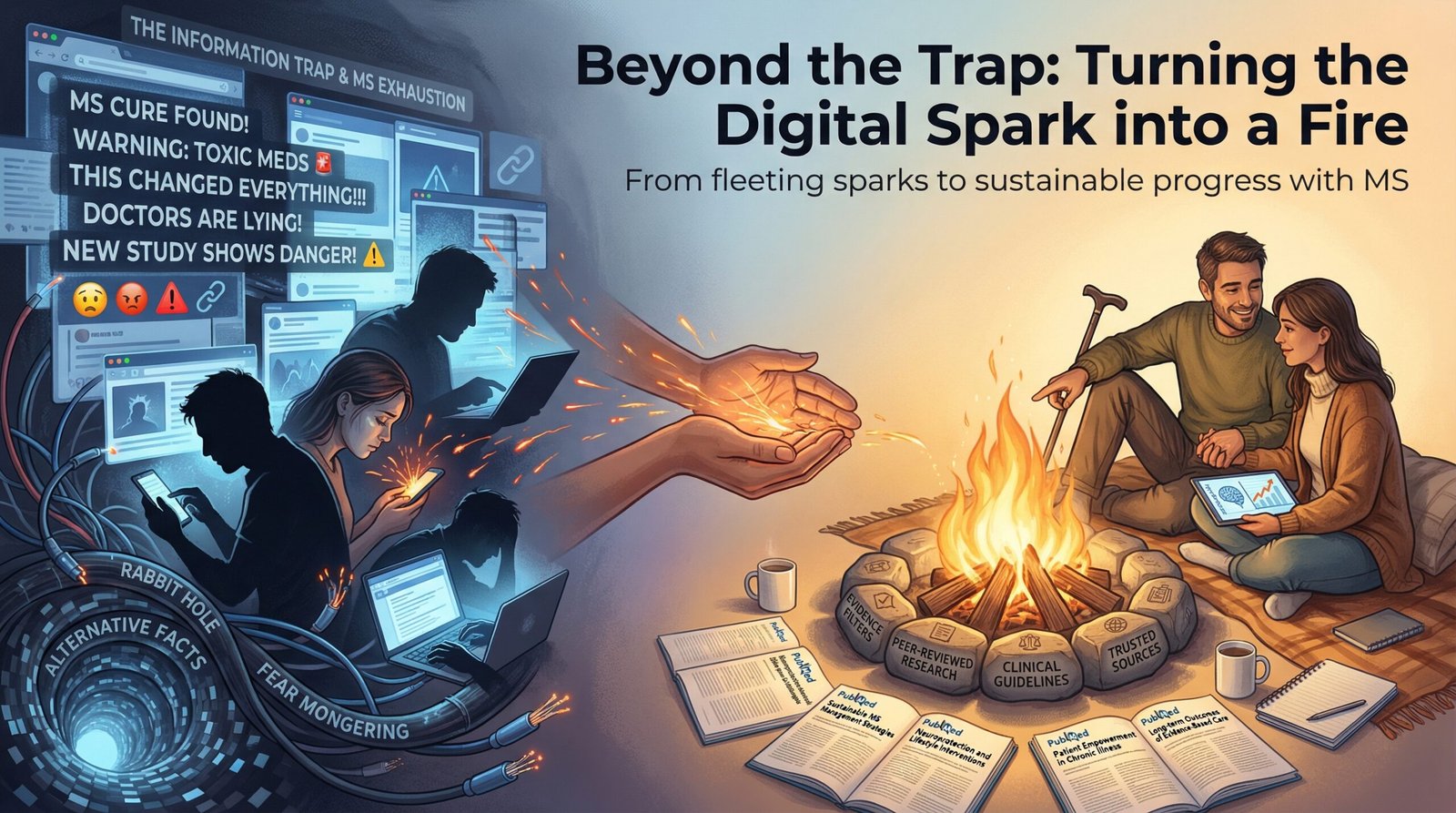
Turning the Digital Spark into a Fire
Our Voyage with MS
We have spent a lot of time talking about the “Information Trap”: those digital rabbit holes and loud algorithms that can leave you feeling more overwhelmed than when you started. If you caught our previous post, you’ll remember the four filters we use to cut through the noise: the Profit Filter, the Timing Filter, the Technology Filter, and the Algorithm Check.
But let’s be honest: the internet is not the enemy. It is a double-edged sword. While one side can lead you into a maze of misinformation, the other side is the very tool we used to change the trajectory of Charlene’s life. The difference isn’t the internet itself; it is how we choose to handle the “sparks” we find there.
Navigating life with MS is exhausting. The unrelenting symptoms, the fear of progression that quietly shadows every good day, the isolation that can creep in even when surrounded by people, and, for caregivers, the burnout of watching someone you love struggle while feeling powerless… these weights are real. In those low moments, when hope feels scarce and the healthcare system frustratingly slow or impersonal, it’s easy to fall headfirst into a digital rabbit hole, grasping at any spark that promises relief. We’ve lived it. That very exhaustion is why the loudest claims can feel so seductive, and why learning to turn fleeting sparks into a steady, sustainable fire can make all the difference.
The Spark vs. The Fire
The internet is incredible at providing a “spark.” A spark is that 2 a.m. discovery: a new idea, a personal story, or a mention of a treatment you had never heard of before. But a spark is not a solution. It is just a beginning.
In our twenty years with MS, we’ve learned that the difference between being misled and being empowered is what you do after you find that spark. If you take a comment in a Facebook group as a medical command, you are at the mercy of the algorithm. If you take that same comment as a research lead, you are the one in control.
Recognizing the “Shouted” Claim
We’ve all seen the posts written in all caps with alarming emojis, shouting absolute statements like “X causes MS!” or “Y is the secret cure!” These claims are dangerous because they exploit our most vulnerable emotions, fear and hope, without providing a shred of context.
These half-truths thrive because they twist a tiny grain of real science into a universal law. You might find a study where a substance affects an immune cell in a petri dish, and suddenly an influencer is claiming it will work for all 2.9 million of us worldwide.
These traps pull hardest when we are exhausted by symptoms that no one seems to be fixing. They sell certainty in an uncertain disease. When we see promises of “secret” protocols, lifestyle overhauls positioned as cures, or “miracle” testimonials that skip the messy middle, we have to recognize the pattern. These aren’t just misleading: they can delay real help and waste precious time and resources while we chase shadows instead of building sustainable progress with our care team.
2018: A Personal Case Study in Advocacy
To see how a spark becomes a fire, look at our 2018 turning point. Twelve years after her January 2006 diagnosis, Charlene was in survival mode. She was on a heavy regimen of Morphine and Methadone, yet her pain level rarely dropped below a 6.
The spark for change came from a forum, not a journal. We read about others finding success with anticonvulsants and SSRIs for neurological pain. We didn’t just “shout” this at our doctor the next day. We spent a full month cross-checking studies on PubMed and the Cochrane Library, acknowledging the limitations in the data and preparing for the friction of a difficult medical conversation.
That month of work turned a forum lead into a sophisticated piece of advocacy. When we met with Dr. Lee at USF in Tampa, we weren’t just asking for a change: we were partners in the decision. Under professional supervision, Charlene made the switch. Her pain level dropped to a 4 or below, and it has stayed there ever since. That wasn’t luck: it was a result of turning a spark into a disciplined fire.
Your Personal Firewall: The Evidence Check
When you encounter a bold claim, use these five questions as your personal firewall. The statement that survives all of them is the one worth your energy:
- Is this true? (Does it hold up to basic logic and established science?)
- Who is saying it? (Is this a peer, a professional, or someone with an agenda?)
- Where is the peer-reviewed data, and what does it actually show?
- Why are they saying it? (Are they sharing a personal journey or issuing a command?)
- What evidence supports or contradicts it? (Where is the peer-reviewed data?)
- What do they stand to gain? (Is there a product, a “secret,” or a subscription for sale?)
These questions aren’t about being cynical: they are about reclaiming your agency. When a lead survives this process, you move from a passive consumer of hope to an active partner in your own care.
A Tip for the Empty Tank: On the days when brain fog or fatigue makes deep research impossible, don’t force it. Save the spark in a note, flag it with one quick question (“What evidence exists?”), and return when you have a clearer head. You can also bring it to your next appointment as a simple discussion point. Self-compassion is a vital part of the process.
The Weight of the “Share”
We have a shared responsibility in this community. We see the newly diagnosed every day: people sitting at their kitchen tables at midnight, terrified and looking for a map. When we share a medical statement without doing an evidence check, we might be handing them a map to a dead end.
There is a world of difference between sharing a funny meme about “cog-fog” and sharing an unvetted medical claim. When we post something as fact, we influence someone else’s journey. Before hitting share, we can ask ourselves: “Am I providing a spark for research, or am I just adding to the noise?”
Reclaiming Your Power
The forums are full of sparks. Some are bright and useful; many are just distractions. You hold the match. By vetting ruthlessly and bridging your research to your medical team, you build a fire that actually provides warmth and light.
Twenty years in, we’ve learned that real progress comes from this discipline, not from chasing every flame. You have more power than the noise wants you to believe. This is how we build a stronger space together, one evidence-grounded step at a time.
What spark are you investigating right now? If you’re comfortable, let’s talk about your evidence-check process in the comments.
Our Voyage with MS 🧡⚡