

Why Two Misunderstood Communities Recognize Each Other Without a Word
Our Voyage with MS
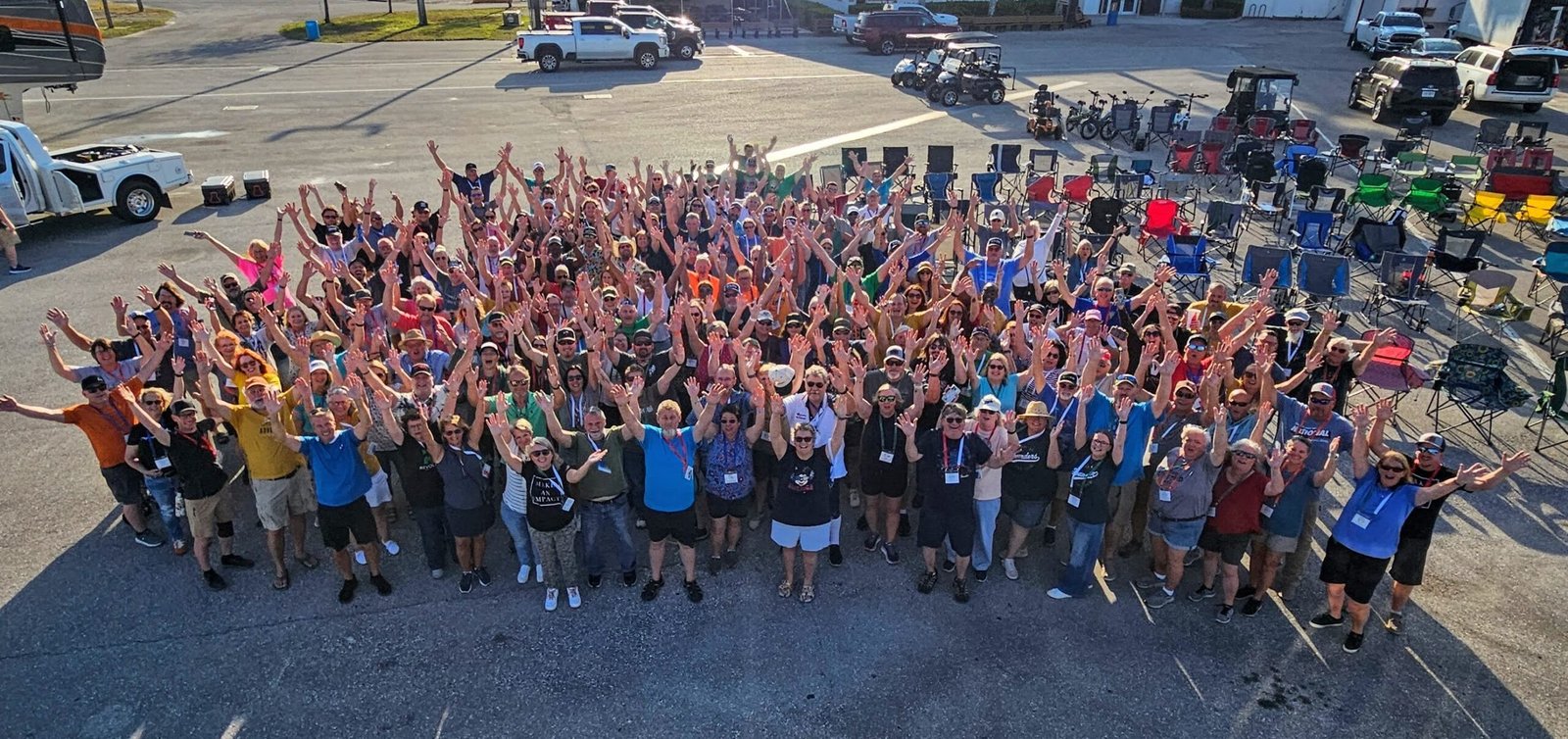
Picture a parking lot at a charity walk. Cars pull in one after another. Doors open. People get out. Normal. Unremarkable. Everyone arrives the same way.
And then you look a little closer.
One trunk opens, and a wheelchair comes out. A van door slides back, and a mobility scooter rolls down the ramp. Someone moves slowly and deliberately, conserving every step. Someone else looks completely fine to the casual observer and is working harder than anyone around them can see.
Now picture a campground. Individual sites, bay doors swinging open, truck beds unloading. Camping chairs hit the ground, the grill comes out, and someone strings up lights. A few sites down, a walker comes out with the gear. Another site, a lift lowers a wheelchair to the ground. And somewhere in between, someone who looks just fine, doing the same invisible calculation they do every single day.
The campground is the same parking lot with more space between the cars. Everyone made it there. The how is different. The showing up is the same.
What nobody sees is everything that happened before that parking lot. The planning. The pacing. The day before rest. The conversation about whether today was going to be a good enough day. The route research. The quiet calculation of how much energy this would cost and whether enough was left in reserve to cover it.
That is invisible work. And it is the most exhausting kind, because the world never sees it and therefore never counts it.
For us as RVers, it looks like this: hours spent on route planning before a single mile is driven. Road conditions, bridge clearances, campsite availability, fuel stops, weather windows, and how far is too far for one day. Every mile is a decision made in advance because a bad one has immediate consequences on the road.
For us living with MS, it looks like this: the same discipline applied to energy instead of miles. What is the forecast today? What did yesterday cost? What does tomorrow need? How far is too far for one body on this particular day? Every commitment is a decision made in advance because overextending has consequences that do not show up until later and cost more than the moment was worth.
Both are the same invisible work. Managing a finite resource across an uncertain landscape. The road and the body require the same respect. The planning is labor. Nobody sees it. Everyone benefits from it.
What the World Sees
We are Kreg and Charlene. We have been full-time RVers since April 2022. Charlene was diagnosed with Multiple Sclerosis in January 2006. At our campsite, I am the one unloading the bay doors and the truck bed. Charlene is the one on the mobility scooter. We are both versions of the outside world’s misread, living in the same campsite.
When people see Charlene, they say she looks fine.
When people see our rig, they say it must be nice to be on a permanent vacation.
Both of those statements come from the same place. They are reactions to what is visible. And what is visible is only the parking lot. It is never the work that got us there.
When Charlene looks fine, she has already spent energy most people will never spend before the day has even started. Managing symptoms, making decisions, calculating costs, preparing for a world that was not designed with her in mind. By the time she walks through any door, she has already done a full shift of work that nobody clocked.
When we appear to be on vacation, we are managing a home, a vehicle, a constantly changing environment, unexpected breakdowns, weather, logistics, and the quiet persistence required to live differently than almost everyone around us. By the time we pull into a campsite, we have already solved three problems nobody else had to solve that day.
Both groups are doing invisible work. Both groups are misread by the same outside world. And both groups know exactly what it feels like to have their reality reduced to a surface impression.
Why We Stay in Our Own Lanes
When the world consistently misunderstands you, you learn to stop explaining. It is not defeat. It is efficiency. You find the people who get it and you stay close to them, because the alternative is spending more invisible energy on conversations that go nowhere.
The MS community stays close to others who live with chronic illness because the shorthand is already there. You do not have to explain a bad day. You do not have to justify a cancelled plan. You do not have to perform wellness to make the people around you comfortable.
The RV community stays close to fellow travelers because they are the only ones who understand the lifestyle. You do not have to explain why you love it. You do not have to defend your choices. You do not have to translate a life that most people have never considered living.
There is another cost to crossing the lane that nobody talks about. Call it the credibility tax. Before either community can connect with someone outside their world, they have to earn the right to be believed. We pay this tax on both sides. When Charlene explains her reality to someone who sees her standing there looking fine and cannot bridge the gap. When we defend our life to someone who sees a permanent vacation and cannot see past it. Both pay the tax every time. And the further you are from your own community, the higher the toll. You spend energy proving your reality before you are even allowed to live it out loud.
Which is exactly why what we found in the RV community caught us off guard. When the lanes merged, the tax disappeared. No proof required. Just the nod.
The Nod
When we started sharing our MS journey with the RV community, there was no flash of pity. There was no polite smile that moved on by tomorrow. There was no tax. Just a nod.
RVers live by systems. They know what it means when a battery cannot hold a charge the way it used to. They know that heat can trigger a shutdown. They know that every high-energy day has a technical cost that shows up later. They know that you cannot simply rest a degraded system back to full. You manage what you have, carefully and intentionally, and you protect it from unnecessary drain.
That is also MS. Word for word.
We did not have to translate. We did not have to find a metaphor and hope it landed. The language was already there. The RV community understood the mechanics of what we were describing because they live a version of it every single day.
Every RVer knows that a single broken part can change an entire week. Every person with MS knows that a single flare can change an entire month. Both communities live in a state of constant maintenance. Both know that the vessel they inhabit, whether it is a motorhome or a body, requires respect and recalibration to keep moving.
When those two realities meet, something clicks. Not sympathy. Not pity. Recognition. A shared understanding that does not need to be explained because it is already felt.
That is rarer than it sounds. And it matters more than most people realize.
What Happens When You Cross the Lane
Here is what we want both communities to hear.
The world does not understand what it cannot see. That is not cruelty. It is just how it works. The flash of pity and the polite smile that moves on are not malicious. They are the natural response of someone who has never been shown what is actually there.
But there is something else happening underneath that. Call it empathy decay. The people who mean well often offer empathy that has an expiration date. It shows up when the story is new, when the diagnosis is fresh, when the moment is visible. And then life moves on. The moment passes. The empathy goes with it.
That is transactional empathy. It is a reaction to a tragedy. It is real in the moment and gone by tomorrow.
What a community offers is different. It is relational empathy. It does not require a fresh story or a visible struggle. It is built into the culture. It is renewed every time someone pulls into a new site, shows up on a bad day, or says nothing and just helps. The world offers a moment of pity. The community offers a seat at the fire.
That is why being transparent matters. That is why sharing our story matters. Not just to raise awareness. But to build a fire that other people can find from a distance. To show the person still sitting alone with their invisible work that the seat exists, and it has their name on it.
Not just at a campground.
Which means the only way to change it is to show them.
When we share our MS journey outside the MS community, we are not just advocating for ourselves. We are closing the gap between what the world sees and what is actually true. Every story shared makes the invisible a little more visible. Every honest conversation chips away at the assumption that looking fine means being fine.
When we share our RV life outside the RV community, we are doing the same thing. We are showing people that this life is not a vacation. It is a choice, a commitment, and a daily practice of problem-solving and resilience that most people never consider.
Both communities carry something worth sharing. Not to prove a point. Not to demand understanding. But because the people who need to hear it most are the ones still sitting in their own parking lots, doing their invisible work alone, wondering if anyone else gets it.
They do. You just have not found each other yet.
Showing Up Is the Whole Thing
MS does not have a month. It has a lifetime. The invisible work does not pause for a calendar. Neither does the need for communities that recognize each other across the lane.
We have found that the RV community and the MS community are more alike than either one fully knows. Both are misread. Both are resilient. Both are doing work the world does not see and would not believe if you tried to describe it.
And both show up anyway.
That is not a small thing. That is everything.
To the RV community: thank you for leaning in when the rest of the world leans away. Thank you for the nod. Thank you for seeing the traveler and not just the diagnosis.
To the MS community: you belong on this road. You do not need a perfect plan. You do not need a big rig or a mapped-out route. You just need to show up. The rest figures itself out.
Route planning. Pacing. Managing a finite resource across an uncertain landscape. Paying the credibility tax. Doing the invisible work before anyone else is awake. For us, these are not two separate disciplines. Every morning we do both at the same table. The road and the body planned together, because on this voyage they have always been the same thing.
To both: cross the lane. Share your story. The invisible work you carry every day is the most important thing nobody is talking about. Start the conversation. Someone out there is waiting for exactly what you have to say.
Let’s see the world, one charge cycle at a time. 🧡⚡