

Why We Stopped Counting Spoons and Started Watching the Battery
A Better Way to Understand MS, Fatigue, Chronic Illness
This is a metaphor. And just like the spoons, this is not a perfect one, and it was never meant to be. No metaphor can fully contain what it feels like to live inside a body that works against you, or to love someone who does. But a metaphor doesn’t need to be perfect to be useful. It needs to be relatable. It needs to build a bridge between an experience someone can’t imagine and something they already understand in their bones. Everyone has felt the anxiety of a dying battery. Everyone has made the calculation. And if that feeling, even for a moment, brings you closer to understanding what Charlene and millions of others navigate every single day, then the metaphor has done its job.
When my wife Charlene was diagnosed with Multiple Sclerosis, I did what any husband would do: I tried to understand it. The medical explanations were ones I could follow. Demyelination. Lesion load. Relapsing-remitting. But understanding the mechanics didn’t solve the real problem.
The real problem was explaining it to people who don’t have that background. People who love her, who want to understand, but who hear the words and still can’t quite grasp what her day actually feels like. Clinical language describes what’s happening in the nervous system. It does almost nothing to explain what it’s like to live in that body, or to live alongside it.
There’s already a framework that many people in the MS community use called Spoon Theory. If you don’t know it, the idea is simple: you start each day with a limited number of spoons, and every activity costs one. When you’re out of spoons, you’re done. It’s a beautiful metaphor, and it’s helped countless people feel understood.
But with MS, you don’t wake up with a full set of spoons. Some are already gone before your feet hit the floor. And if you’re on the outside trying to understand that, “I only have so many spoons today” can still feel abstract. You nod. You try. And then you forget, because spoons don’t live in your gut the way experience does.
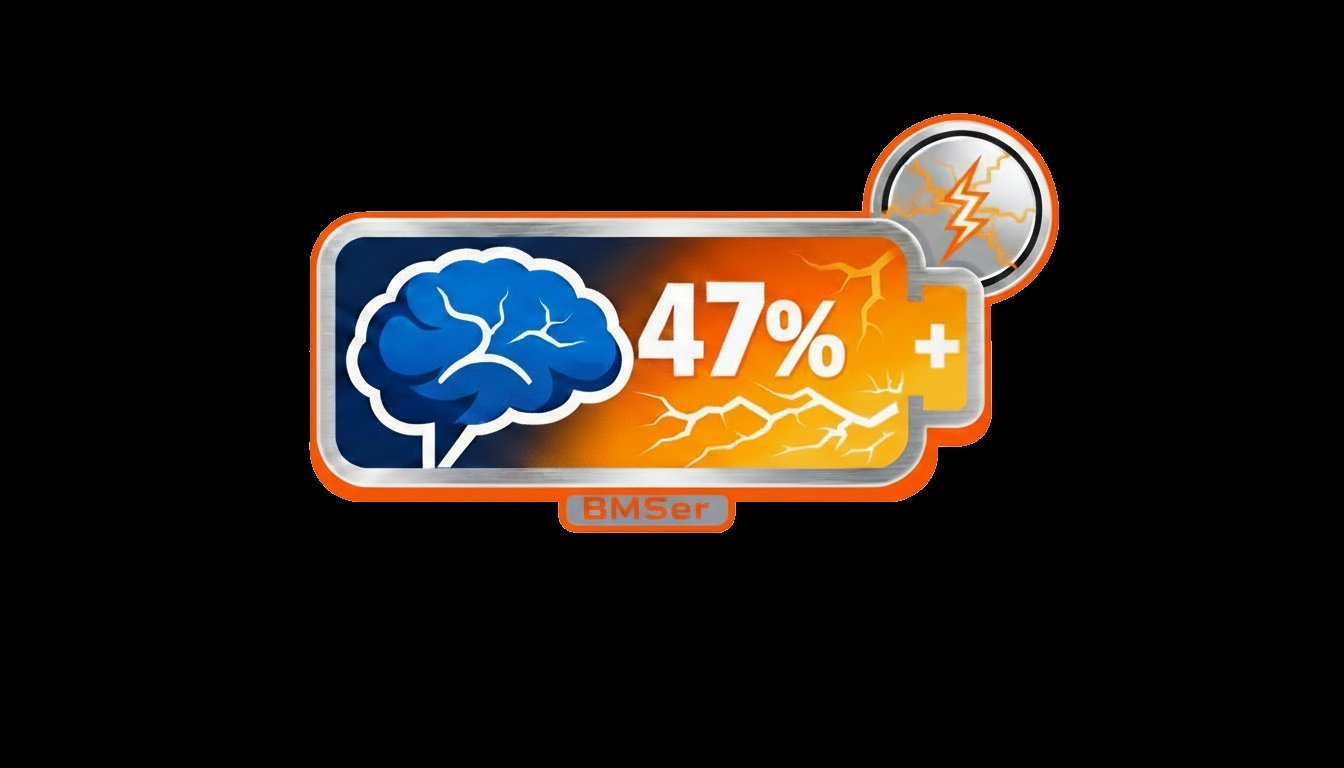
A dying phone does. Every single person reading this has been there. Stranded somewhere, watching the battery tick from 8% to 7%, making deals with themselves about what they absolutely need versus what can wait. That panic is real. That calculation is instinctive. And we’ve all woken up in the morning to a phone that didn’t charge properly, or got left on all night, and felt that immediate dread before the day even started. 47%.
That, I realized, is exactly what Charlene does every morning before she gets out of bed.
The moment that changed everything wasn’t in a doctor’s office. It was an
ordinary morning. Charlene was sitting on the bed, not moving. Not deciding what to do next, not resting between tasks. Just still. And something about the quality of that stillness made me stop and actually look.
She was checking her charge. 47%.
I’d seen that look before. Not on her. On myself. It’s the look you get when your phone is at 23%, and you’re an hour from home, and you’re doing the mental math: Can I make it? Should I go into low power mode? What if I need GPS later? That micro-calculation. The weighing of what you need against what you have left.
She wasn’t looking at a screen. She was checking her body. And once I saw it, I couldn’t unsee it, because I realized I was doing the same calculation. Just from the outside.
That’s when the framework clicked into place. MS isn’t just a medical condition to be explained in clinical terms. It’s a battery management problem. And we’re both running the system.
The Phone Nobody Warns You About
Think of MS as a smartphone with a badly degraded battery. From the outside, the phone looks perfect. Sleek, functional, capable. But the battery is worn. It starts each day far below 100%, drains fast even when idle, overheats in conditions a healthy phone would handle without a second thought, and risks permanent damage if pushed past its safety threshold.
Charlene lives inside that phone, feeling the charge drop in real time, reading the fault codes as they come, making the shutdown calls before the system crashes. I live outside it, watching the indicators, calculating the load, monitoring the environment.
Every phone already has a Battery Management System built in, called a BMS. It’s been there quietly the whole time, managing charge cycles, protecting the cells, keeping everything running within safe limits. But when the battery degrades, that BMS has to work overtime. And suddenly, you become hyper-aware of what it’s doing, because now you’re part of the management process too.
We’re both BMSers. Just with different telemetry.
The acronym works two ways, and that’s not an accident. BMS stands for Battery Management System, which is the built-in technology that keeps your phone’s battery running within safe limits. But it also stands for Body Management System, which is exactly what Charlene’s nervous system is doing every single moment of every day, and exactly what I’m doing alongside her. The “er” at the
end makes us both operators. Same system. Different vantage points.
The Four Jobs We’re Both Doing
1. Monitoring: The Starting Number Is a Lie
When charged overnight, a healthy phone wakes up at 100% with barely any background drain. A degraded battery? It’s already burning power just keeping the operating system alive. The screen is off, but the system is working overtime, compensating for failing cells, managing inefficiencies that used to be effortless.
That’s MS. The starting charge isn’t 100%. It’s 70%. Or 50%. Some days, 30% or less, because the body’s base load, the energy cost of just existing, is catastrophically higher when your nervous system is degraded. Demyelinated nerves (nerves that have lost their protective myelin insulation) require 3 to 5 times more energy to transmit the same signal. That’s not fatigue. That’s a massive structural inefficiency baked into every single moment.
So when Charlene wakes up and says she’s already tired, she’s not being dramatic. She’s reporting accurate telemetry. Her system booted up already deep in the red.
2. Protection: The Emergency Shutdown
You know what happens when you ignore the 5% warning? The phone dies mid-sentence. The text doesn’t send. The call drops. The GPS shuts off while you’re lost.
So you learn. You don’t push it. At 20%, you find a charger. At 10%, you go into low power mode. At 5%, everything non-essential stops.
That’s what Charlene is doing when she says she can’t. She’s not giving up. She’s not being lazy. She’s executing a protective shutdown, a Low-Voltage Disconnect, to prevent permanent damage.
Here’s what makes this more than a metaphor: in a lithium cell, chronic overuse accelerates capacity fade, the gradual, irreversible loss of the electrode material’s ability to hold a charge. The structure degrades at the molecular level and cannot be restored.
I know demyelination isn’t the same as a battery degrading at the chemical level. But the functional outcome is comparable: a system that can no longer deliver what it once could, that works harder for diminishing returns, and that cannot be restored to what it was. The mechanism is different. The result rhymes.
Different mechanisms. Same principle. Push a stressed system too hard, and you don’t just drain it. You break it permanently.
When she says she can’t, what she means is: If I do this, I will damage myself in ways I can’t repair.
3. Balancing: There Is No Reset Button
A healthy battery has clean, efficient chemistry. A degraded one? Capacity fades. Internal resistance climbs. And here’s the thing that catches people off guard: internal resistance is invisible at rest.
A degraded battery might read 80% and seem fine. But the moment you draw real current: open a demanding app, start navigation, turn on the camera. The voltage sags. The battery can’t deliver power efficiently under load, even when it looks charged. The charge was real. The delivery capacity wasn’t.
This is why Charlene can seem okay at breakfast, present and capable, and then hit a wall the moment there’s genuine cognitive or physical demand. Not because she was pretending. Because internal resistance is invisible until the load hits.
And rest doesn’t fix it. In a large battery system, like the one in our RV, you can run an equalization cycle, forcing the cells to rebalance and partially restoring efficiency. But a smartphone battery doesn’t get that option. Once the chemistry degrades, it stays degraded. You can charge it to 100%, but that 100% isn’t the same 100% it used to be.
MS is the same way. The nervous system is compromised at the structural level. Rest helps. It slows the damage, prevents crashes, and keeps the system viable. But it doesn’t restore the battery to factory condition. It never will.
That’s why “just get more sleep” doesn’t work. That’s why a vacation doesn’t cure MS. You’re not recovering from overuse. You’re managing a permanently compromised system.
4. Communication: Reading the Fault Codes
Your phone tells you when something’s wrong. The battery icon turns red. A warning pops up. The screen dims.
In MS, the warnings are called symptoms, but they’re really fault codes. Tingling? That’s the signal-to-noise ratio dropping on damaged nerve fibers. Brain fog? That’s the processor throttling because the system is overloaded. Heat sensitivity? That’s thermal protection kicking in before the whole thing crashes.
These aren’t bugs. They’re diagnostic alerts from a system doing its best to tell you it’s entering limp mode, the state where it limits functionality to prevent total failure.
Why “I’m Tired” Means Critical Failure
When Charlene says she’s tired, people hear it like a healthy phone at 60%. Like she just needs a quick nap or a coffee. Like it’s optional.
But what she’s actually saying is: I’m at 8%. If I don’t shut down right now, I will crash in a way that damages me permanently.
That’s not tiredness. That’s an emergency shutdown protocol.
The problem is the language. We use the same word to describe staying up too late and a nervous system on the edge of catastrophic failure. So nobody understands the urgency.
Imagine if your phone could talk, and at 8%, it said it was “a little drained.” You’d think it’s fine, you’ll charge it later. But what it meant was: If you don’t plug me in right now, I will corrupt the OS and never charge past 60% again.
That’s MS. The communication gap isn’t because people with MS are bad at explaining. It’s because the scale is broken. Tired doesn’t mean tired. It means imminent system failure.
When Heat Becomes a Physical Multiplier
You know exactly when your phone is going to betray you: when you need it most.
You’re using GPS on a hot day. Filming something in the sun. Making a call after it’s been in your pocket on a summer walk. And suddenly: Device is too warm. Performance may be affected. The screen dims. Apps lag. The camera refuses to open.
That’s thermal throttling. The processor slows down. Functionality gets stripped away. The phone enters survival mode. And it always happens when you need it most.
MS does the exact same thing. It’s called Uhthoff’s Phenomenon. When Charlene’s body temperature rises, from heat, exertion, stress, or even a hot shower, the demyelinated nerves slow down even further. Signals that were already struggling get worse. Vision blurs. Limbs go heavy. Thinking becomes impossible.
This isn’t “feeling tired from the heat.” It’s the nervous system executing an emergency thermal protection protocol. The body is throttling everything, movement, cognition, and vision, to prevent a total system meltdown.
The environment isn’t just uncomfortable. It’s a physical multiplier on an already compromised system. Heat doesn’t make MS worse temporarily. It reveals how much harder the system is already working just to function at baseline.
Two BMSers, One Irreplaceable Device
Here’s what I understood that morning, watching Charlene:
We’re both managing the same system. She monitors from the inside, feeling the charge drop, reading the fault codes, and making the shutdown calls. I monitor from the outside, watching for environmental stressors, calculating loads, and asking whether we have enough charge for this.
We’re both BMSers. Just with different telemetry.
And the question of getting another phone doesn’t exist, because this isn’t a phone. It’s the phone. The one with every photo that matters. Every conversation that shaped me. Every memory, every connection, every piece of my life I care about.
The hardware might be degraded. The data is irreplaceable.
You don’t trade that in. You learn to manage it. You adapt. You become fluent in battery management not because it’s noble, but because it’s obvious. Of course, you protect what you can’t replace. What else would you possibly do?
What System Management Actually Looks Like
Living with MS isn’t a tragedy. It’s not inspiration. It’s not overcoming or battling or any of that language people use to make chronic illness feel cinematic.
It’s system management.
We check the charge every morning. We calculate the base load. We monitor environmental conditions: heat, cold, stress, and cognitive demand. We make hard calls about what we can and can’t afford to do. We protect the hardware. We enforce shutdowns when the system hits critical thresholds. We schedule deep rest to slow the degradation.
We are both BMSers. Operators of a high-maintenance, irreplaceable system.
And if you’re living this too. Whether you’re checking your own telemetry every morning or watching someone you love navigate a degraded battery, own the title.
You’re not coping. You’re not just managing symptoms.
You’re operating a compromised system with precision, protecting irreplaceable hardware, and keeping the lights on, one careful decision at a time.
That’s not a weakness. That’s expertise.
Let’s see the world, one charge cycle at a time.
TL;DR: The Short Version
Multiple Sclerosis is comparable to a smartphone with a badly degraded battery. From the outside, the phone looks fine. Inside, the battery starts every day below 100%, drains fast even at rest, and risks permanent damage if pushed too hard.
My wife Charlene lives inside that phone. I live outside it. We’re both Battery Management System operators, BMSers, for the same irreplaceable device.
What “tired” really means:
Her nervous system’s baseline energy cost is massively higher. Demyelinated nerves require 3 to 5 times more energy just to send normal signals. Many mornings, she boots up already at 30 to 50%. That’s accurate telemetry, not exaggeration. Every decision is a battery calculation.
The four BMS jobs we both handle:
Monitoring: Her starting charge is a lie. Background drain from just existing is enormous.
Protection: Saying “I can’t” isn’t quitting. It’s an emergency shutdown. The functional parallel to battery capacity fade is real: push a compromised system too hard and you reduce what it can deliver, permanently.
Balancing: There’s no equalization cycle in MS. Deep rest slows damage and prevents crashes, but never resets the system to factory specs. Internal resistance is real and invisible until the load hits.
Communication: Symptoms are fault codes. Tingling = signal noise. Brain fog = processor throttling. Heat sensitivity = thermal protection (Uhthoff’s Phenomenon) kicking in right when you need it least.
The partnership:
We manage one high-maintenance, irreplaceable system together. She reads internal telemetry. I watch external stressors. We calculate loads, enforce rest, and make hard calls to keep the lights on.
This isn’t tragedy or inspiration. It’s the precision engineering of a compromised device we both love.
If you live this too, whether you’re checking your own charge every morning or watching someone you love do it, own the title: BMSer. You’re not just coping. You’re a skilled operator protecting what matters most, one careful cycle at a time.
The Elevator Pitch
A BMSer is someone who manages life like a phone with a degraded battery. Battery Management System for the device. Body Management System for the person. The “er” makes you both operators. And unlike spoons, everyone already knows the dread of waking up to a phone that didn’t charge.